It doesn’t announce its arrival. It doesn’t rely on speed to survive. Instead, it slips through defended airspace with minimal signature, designed to strike the most protected targets on Earth.
With the B-2 Spirit, stealth became the foundation of strategic reach, allowing missions once requiring entire strike packages to be carried out by a single penetrating aircraft.
Here’s how the B-2 came to define strategic bombing in the stealth era, and why it still matters today.
What Is the B-2 Spirit?
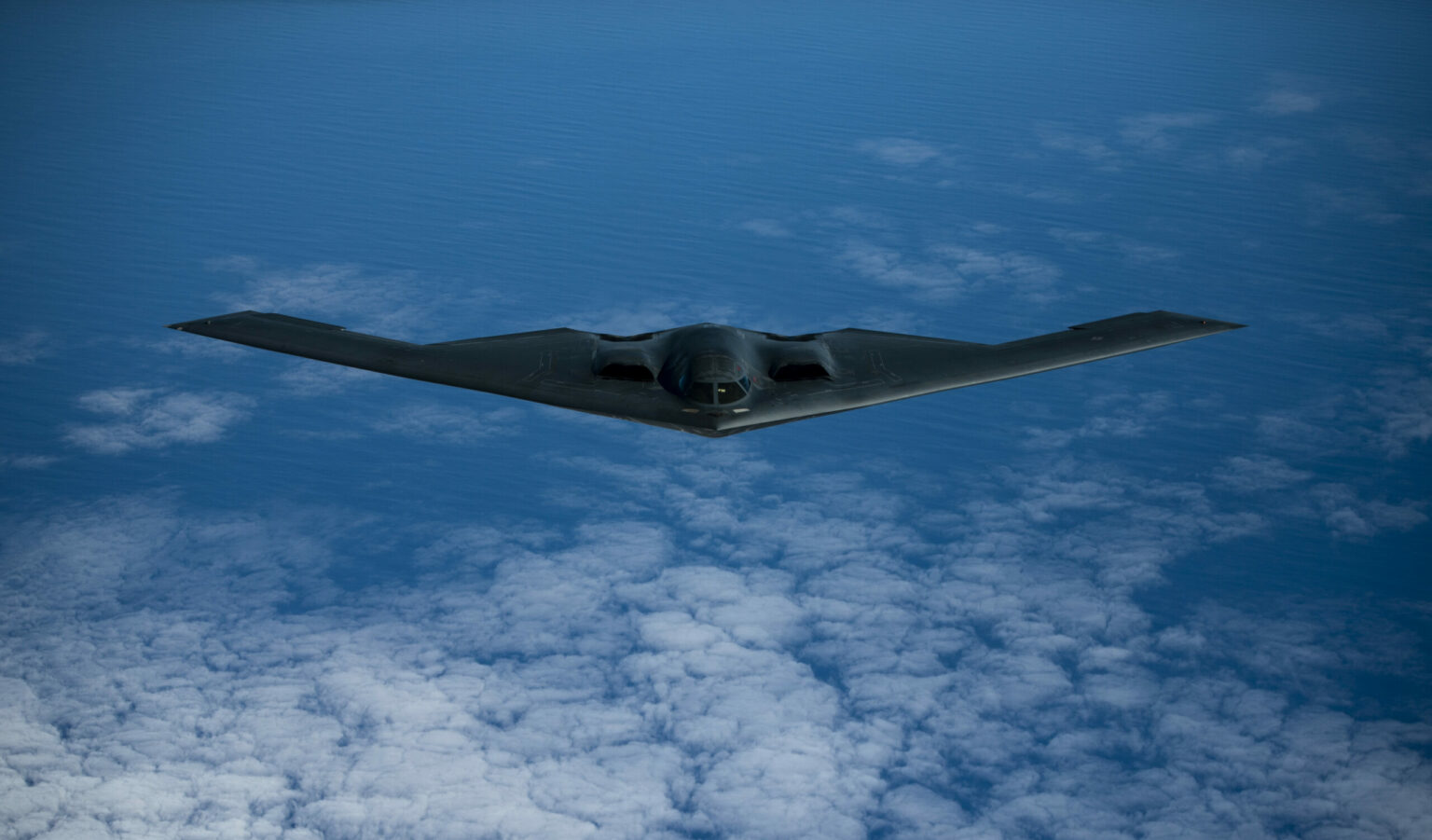
The Northrop Grumman B-2 Spirit is a long-range stealth strategic bomber operated by the US Air Force, designed to penetrate advanced, layered air defenses and deliver precision effects at intercontinental distances.
It supports a range of mission sets, from conventional strike against hardened or high-value targets to nuclear deterrence as part of the US strategic nuclear triad.
Optimized for deep-strike operations, the aircraft enables missions that would traditionally require large, escorted strike packages, compressing that capability into a single penetrating platform that can operate in highly contested airspace.
| Category: | Details: |
| Type | Stealth strategic bomber |
| Role | Long-range strategic strike and nuclear/conventional bombing missions |
| Operator | US Air Force |
| Manufacturer | Northrop Grumman |
| Crew | 2 |
| Length | 69 feet (21 meters) |
| Wingspan | 172 feet (52.4 meters) |
| Height | 17 feet (5.2 meters) |
| Maximum Takeoff Weight | 336,500 pounds (152,634 kilograms) |
| Powerplant | 4 x General Electric F118-GE-100 turbofan engines |
| Maximum Speed | High subsonic |
| Range | Approximately 6,000 nautical miles (6,905 miles/11,110 kilometers) unrefueled |
| Aerial Refueling | Yes |
| Stealth Features | Flying-wing design, radar-reducing materials, low observable shaping |
| Payload Capacity | Up to 40,000 pounds (18,144 kilograms) of ordnance |
| Nuclear Capacity | Yes |
| Conventional Weapons | JDAMs, gravity bombs, precision-guided munitions |
Origins and Development
The B-2 program emerged in the late Cold War under the Advanced Technology Bomber initiative, driven by the need for an aircraft capable of penetrating increasingly advanced Soviet air defenses.
Development was led by Northrop Grumman, building on earlier flying wing concepts pioneered by Jack Northrop. The result was one of the most advanced — and expensive — aircraft ever built.
Key Milestones:
- November 22, 1988: The B-2 Spirit was publicly unveiled at Air Force Plant 42 in California
- July 17, 1989: First flight at Edwards Air Force Base
- December 17, 1993: Spirit of Missouri, the first operational aircraft, was delivered
- 1997 and 2003: Initial and full operational capability, respectively
- 1999: Spirit’s combat debut during Operation Allied Force (NATO bombing of Yugoslavia)
The aircraft went on to conduct long-range missions over Afghanistan during Operation Enduring Freedom and flew 22 sorties in Operation Iraqi Freedom, delivering over 1.5 million pounds (680,388 kilograms) of munitions from both forward locations and Whiteman AFB.
In 2009, it was assigned to Air Force Global Strike Command, formally tying it to the US strategic strike mission.
Variants and Fleet Structure
Unlike many military aircraft programs, the B-2 Spirit exists as a single primary configuration.
Rather than developing multiple variants, the US Air Force has focused on continuously modernizing the small fleet to keep it effective against evolving air defense systems.
Over time, the bomber has received upgrades to its radar, avionics, communications systems, and weapons integration, improving both survivability and strike flexibility.
Modernization efforts have also strengthened the aircraft’s ability to operate within networked and multi-domain warfare architectures.
Each B-2 in the fleet is maintained to a high standard, with incremental modernization ensuring continued relevance.
How the B-2 Spirit Works
The B-2 combines low observability, long-range endurance, and precision strike capability.
Key Features
- Flying wing stealth design minimizing radar cross-section
- Advanced radar-absorbing materials
- Global strike capability with aerial refueling
- Large internal bomb bays (no external weapons)
- Two-person crew (pilot + mission commander)
Strengths
- Exceptional stealth and survivability
- Ability to strike heavily defended targets
- Long range with intercontinental reach
- Flexible payload options (conventional and nuclear)
- Proven capability in precision strike missions
Limitations
- Extremely high cost per aircraft and maintenance
- Small fleet size (limited availability)
- Subsonic speed
- Maintenance-intensive stealth coatings
Global Use and Combat Operations
The B-2 has been used in multiple high-profile operations, often striking heavily defended targets early in a campaign.
Combat History
- Kosovo War: First combat use, precision strikes
- War in Afghanistan: Long-range missions from the US mainland
- Operation Odyssey Dawn: Strikes against Libyan air defenses
Operational Role
- First-day-of-war strike platform
- Deep penetration missions
- Strategic deterrence
- Global power projection
Its ability to launch missions directly from the continental United States underscores its global reach and flexibility.
Future Outlook
The B-2 is expected to remain in service into the 2030s, alongside and eventually replaced by the Northrop Grumman B-21 Raider.
Key trends:
- Continued avionics and communications upgrades
- Integration into networked and multi-domain operations
- Gradual transition to next-generation stealth bombers
Even as newer platforms emerge, the B-2 continues to serve as a benchmark for stealth bomber design.
Source: Defence Post