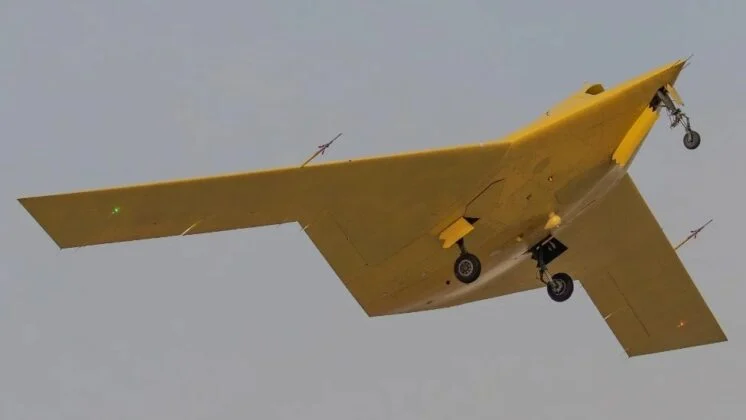
China’s newest long-endurance stealth unmanned aerial vehicle, the CH-7, has completed its maiden flight.
State broadcaster CCTV said on Monday that China’s new high-altitude, high-speed, long-endurance CH-7 had recently completed its first flight.
The outlet reported that the aircraft demonstrated long endurance, stealth, and high cruising speed, and was designed to meet “the needs of ground observation, data support and communication under complex conditions.” CCTV said the drone will now undergo additional testing, including verification of its flight performance envelope and validation of payload functions.
The CH-7 is part of the Caihong, or CH, series of unmanned aerial vehicles developed by the China Academy of Aerospace Aerodynamics, a subsidiary of the China Aerospace Science and Technology Corporation. The CH family is among China’s most widely marketed UAV lines and has been promoted internationally for both military and security missions.
The aircraft was first introduced publicly in 2018, when a full-scale model appeared at the Zhuhai Airshow amid speculation that it would serve as a long-range reconnaissance and strike platform. An actual CH-7 airframe was displayed again at last year’s Zhuhai event, signaling progress toward flight testing after years of design changes.
Chinese state media now emphasize that the current configuration is intended solely for reconnaissance. “The current version of the CH-7 is a high-speed reconnaissance aircraft,” Fang Shuai, one of the drone’s designers, told CCTV in May.
Fang said the aircraft’s defining feature is its flying-wing layout, which integrates the wing and fuselage into a single structure to reduce radar signature while maintaining aerodynamic efficiency. According to Fang, the engine air intakes are mounted above the fuselage, while the exhaust uses a semi-concealed nozzle design to further limit observability. In footage aired by CCTV, the drone appears as a wide, flat flying wing with smooth contours consistent with low-observable design principles.
Fang said the CH-7 is intended to penetrate contested areas quickly, collect reconnaissance data, and relay information from the front lines to manned aircraft and long-range strike forces, enabling target guidance without exposing crewed platforms. Earlier reports had suggested the aircraft would fly in 2019, but subsequent coverage indicated that the program underwent several redesigns.
Those changes are reflected in updated specifications released by Chinese media. The wingspan has reportedly increased from 22 meters to 27.3 meters, while maximum takeoff weight has been reduced from about 13 tons to 8 tons. The CH-7’s cruising speed is now listed at Mach 0.5, with a service ceiling of roughly 16,000 meters and a maximum endurance of about 16 hours. Analysts believe the drone’s reconnaissance radius exceeds 2,000 kilometers.
Another designer told CCTV last year that the CH-7 was revised specifically for covert reconnaissance in high-risk areas. He said the weapons bay was removed, stealth features were refined, the wingspan was increased, and overall weight was reduced. According to that designer, the aircraft’s stealth characteristics are comparable to those of the United States’ RQ-180 unmanned reconnaissance aircraft, though no independent data has been released to support that claim.
The broader CH drone series has been widely promoted by Chinese state media as one of the country’s most successful defense exports. In 2016, People’s Daily said the line represented China’s “bestselling drones” and reported that more than 10 countries had purchased models from the series. Other reports have named buyers including Saudi Arabia, Pakistan, and Nigeria, though those exports involved earlier armed or reconnaissance variants rather than the CH-7.