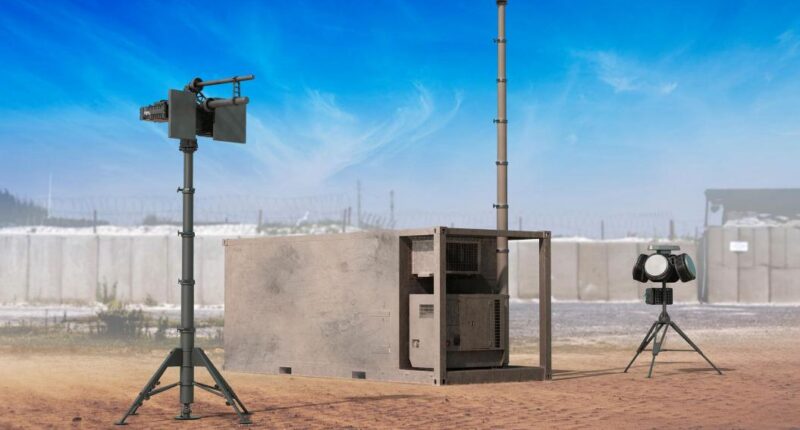
Falcon Shield uses a standard ISO container, HYAS command-and-control system, and Nerio ultra-long-range surveillance and target-acquisition.
Britain’s Falcon Shield counter-unmanned aerial system (C-UAS) can now deploy straight out of a box.
Leonardo and Marshall Land Systems have unveiled a new variant that packs key elements of the system into a standard ISO container, allowing it to move rapidly by air, land, or sea.
Inside are Leonardo’s HYAS command-and-control system and Nerio ultra-long-range surveillance and target-acquisition capability, creating a deployable hub for detecting and responding to hostile drones.
The new setup means operators can load the C-UAS solution onto military transport aircraft, road vehicles, or ships for rapid deployment wherever drone protection is needed.
Leonardo said Falcon Shield’s open architecture also allows it to connect with radars, electronic surveillance measures, and electro-optical and infrared sensors to create a layered counter-drone defense.
“Falcon Shield has been developed to give operators and commanders flexibility,” said Paul Norry, UK campaign manager for Falcon Shield at Leonardo.
“By putting this proven capability into a standard ISO container, we are making it even easier to deploy rapidly, scale as requirements change, and network with other Falcon Shield systems to meet an ever-evolving threat with minimal infrastructure requirements.”
The companies showcased the new variant during Defence Vehicle Dynamics 2026 at UTAC Millbrook in the UK from September 16 to 17.
Inside Falcon Shield C-UAS
Designed to detect, track, and defeat hostile drones, Falcon Shield is previously available in a fixed-site configuration.
Its UK military version, known as Orcus, uses radar to detect drones by their radar cross sections and radio-frequency sensors to pick up signals from the aircraft and their operators.


An ultra-long-range thermal imaging camera further helps identify and track potential threats, giving operators a broader view of activity around an airbase.
Early detection gives personnel more time to assess a threat and determine the appropriate response before it reaches a sensitive area.
Orcus officially entered service with the Royal Air Force in 2018.
Source: NextGen Defence