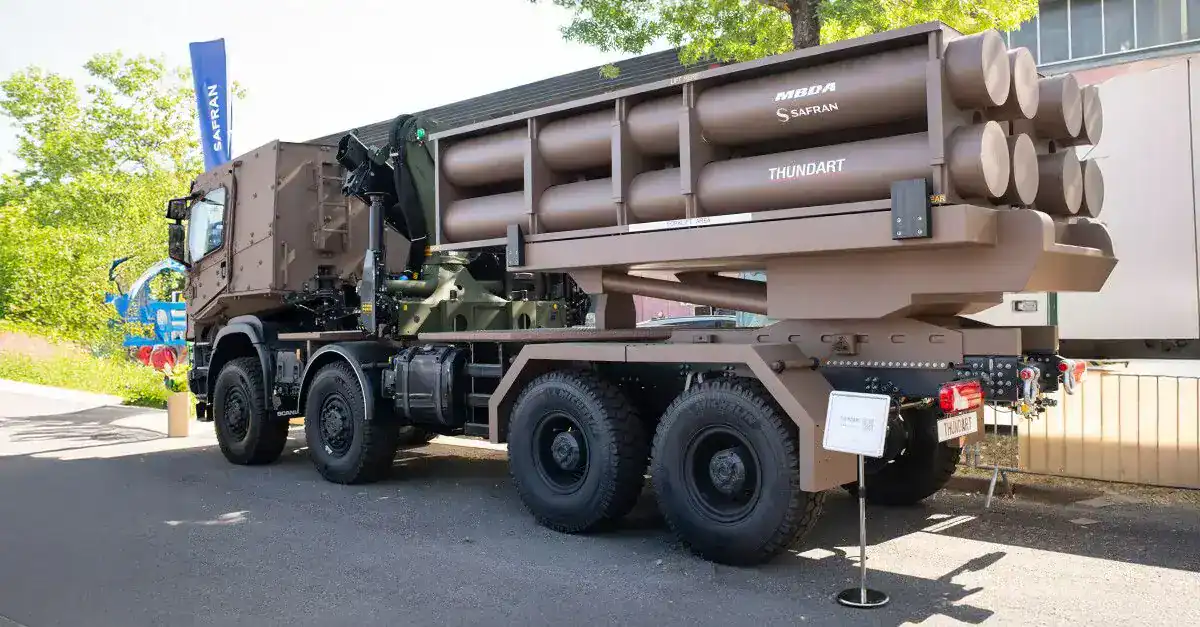
France’s Ministry of the Armed Forces aims to accelerate the replacement of the LRU multiple launch rocket system with the Thundart system developed by Safran and MBDA.
Forces Operations Blog reported this after analyzing the draft law on France’s 2027 budget.
The ministry is considering accelerating the schedule for ordering and delivering launchers and rockets. This could help make up for a six-month delay in the decision to launch the program in 2024 and mitigate the effects of a temporary capability gap.
The official target remains “by 2030,” when the LRU systems are scheduled to be retired. However, the manufacturers say they could provide initial capabilities as early as 2029.
In addition, the new document changed the target quantity from 26 to “at least 26” launchers and 300 munitions.
However, only half of the required fleet has been contracted so far, and an order for the second batch of 13 systems is not planned for 2027.
The overall quantity remains well below the French Army’s needs and the target set out in the updated military programming law: equipping three artillery battalions and acquiring up to 52 launchers.
Thundart Rocket System
Thundart is being developed to replace France’s LRU multiple launch rocket systems, created by upgrading U.S. M270 MLRS launchers with the EFCS fire-control system, a new navigation system, and modern communications equipment.
Safran Electronics & Defense and MBDA, which were selected to develop the system in September, will establish a dedicated joint venture in the Paris region in January 2027. It will be responsible not only for implementing the French program but also for promoting the system for export.
Safran will supply the new rocket’s GPS/INS guidance and navigation system, already used in the AASM family of guided air-to-ground bombs. MBDA is responsible for the rocket body, warhead and fuze, while Roxel has developed a solid-fuel rocket motor for the program.
Thundart is currently designed to use 227 mm guided rockets compatible with existing LRU launchers. They can reach “high supersonic” speeds and have a range of up to 150 km.
In April 2026, the developers conducted a successful demonstration launch. Current plans also call for developing rockets with a range of up to 500 km by 2035.
The launcher will be mounted on a Scania 8×8 truck chassis fitted with a rotating mount designed to carry two launch pods. Each pod holds four rockets.
Source: Militaryni