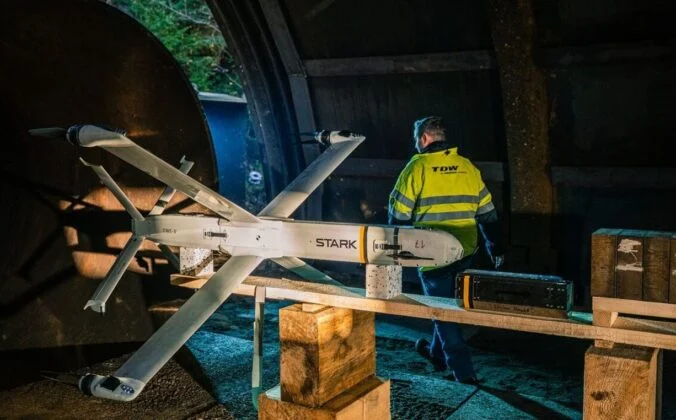
Germany has reached a new milestone in loitering munition development after a successful live-fire test combining the LION STRIKE 110 warhead with the VIRTUS drone, according to statements released by TDW and STARK.
As noted by the companies, the demonstration marked the first time the LION STRIKE 110 (LS110) warhead was fired live from the VIRTUS loitering munition. The test took place in Schrobenhausen and confirmed that the warhead, fuze, and carrier platform functioned together as intended.
TDW and STARK said the successful test shows that a German-developed kamikaze drone system is moving from concept toward operational readiness. According to the companies, the Bundeswehr could potentially begin fielding loitering munitions starting at the end of 2026, depending on procurement decisions.
The demonstration was conducted only months after TDW and STARK signed their cooperation agreement, which the companies described as evidence that German defense programs can now move at a faster pace. In a statement, TDW Chief Executive Andreas Seitz said, “We are implementing what we announced – faster, more focused, and more consistently in the spirit of the Zeitenwende.”
Defense Network has reported, citing sources close to the German Army, that the Bundeswehr expects to be equipped with loitering munition as early as next year. TDW and STARK, however, said they are formally referring to delivery capability by the end of 2026. The companies added that by 2027 they aim to be able to provide “thousands of systems with integrated warhead and fuze systems.”
The LION STRIKE 110 is part of a new warhead family developed by TDW. According to the company, the design is optimized for large-scale production and rapid availability. TDW said it is pursuing an approach in which warheads are produced in advance and later integrated with new carrier platforms, including kamikaze drones and guided missiles.
TDW said the LION STRIKE family includes three different calibers and is offered in multiple configurations. These include a purely armor-piercing version as well as a multi-effect variant. The company stated that tandem shaped charges, fragmentation sleeves, and different weight classes allow the warhead to be tailored to a wide range of targets, including vehicles equipped with reactive armor.
Loitering munition, often referred to as kamikaze drones, has changed modern ground combat by combining reconnaissance and strike capabilities in a single system. These weapons can loiter over an area, identify targets, and engage at a chosen moment, reducing reaction time and increasing flexibility for commanders.
STARK contributes the VIRTUS drone platform, which the company described as a scalable and modular system. According to STARK, the design allows operators to adjust effect and mission profile depending on operational requirements. The company said commanders will be able to decide, based on the tactical situation, when and how targets are engaged.
The VIRTUS is intended to serve as a domestically produced loitering munition for the Bundeswehr. STARK said its modular architecture is designed to support different payloads and mission sets, making it adaptable to evolving battlefield needs.
STARK co-founder Dr. André Schneider said the project is not limited to Germany. In a statement, he said, “We are providing NATO and Ukraine with a weapon system that penetrates even the strongest armor and is available in large quantities. In doing so, we are securing core capabilities that NATO forces and allies urgently need on the modern battlefield.”