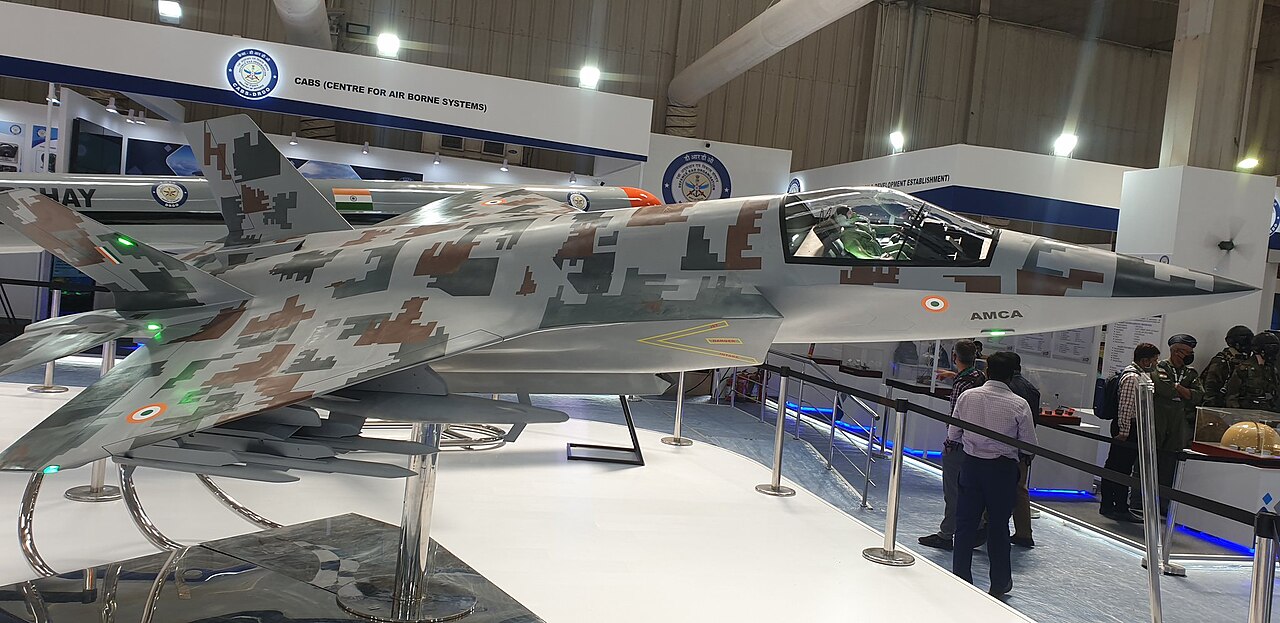
India’s state-owned aerospace manufacturer Hindustan Aeronautics Limited (HAL) has been ruled out of contention to manufacture the country’s first fifth-generation fighter aircraft.
The decision has been attributed to the company’s existing order book, which is reported to be nearly eight times its annual turnover, limiting its capacity to take on the new program.
According to Indian media reports, three consortia comprising domestic private and public sector entities — led by Larsen & Toubro, Tata Advanced Systems Limited, and Bharat Forge — have been shortlisted to build five prototypes of the Advanced Medium Combat Aircraft (AMCA).
A total of seven firms had initially competed for the estimated 150-billion-rupee ($1.66 billion) contract and were assessed on technical grounds. The final winner is expected to be selected on a lowest-cost basis, with an announcement expected within three months.
Bet On Private Sector
Among the shortlisted bidders, Tata Group is the only company with prior experience in establishing a final aircraft assembly line, having done so for the C-295 transport aircraft in partnership with Airbus.
That program demonstrated the private sector’s ability to manage complex aerospace integration with international partners and, notably, was also executed without HAL’s participation.
The developments underscore the government’s push to tap the potential of India’s private sector while easing the burden on HAL, which has already been contracted to deliver over 180 LCA Tejas fighters and 156 combat helicopters.
However, a recent technical assessment of Indian private-sector firms has raised concerns over their ability to manufacture major aircraft structural assemblies, according to The New Indian Express.
While a limited number of firms showed credible capabilities in composites, metallic structures, and quality systems, many failed to meet fighter-grade production standards, the outlet added, citing sources.
“The evaluation flagged limited experience in manufacturing large composite assemblies, inadequate autoclave capacity and a heavy dependence on subcontracting for core processes, issues that are viewed unfavourably in programmes involving safety-critical combat aircraft structures,” The New Indian Express wrote, quoting sources.
“In several cases, companies also fell short on certification requirements and financial depth, which raised concerns about their ability to sustain long, complex development and production cycles.”
Road Ahead
The selected candidate will work with the government’s Aeronautical Development Agency to construct the AMCA prototypes and one structural test specimen by 2031.
The development phase is expected to conclude by 2034, with serial production and induction beginning from 2035.
The Indian Air Force plans to induct around 120 AMCA platforms, with the initial 40 Mk-1 variants powered by GE Aerospace’s F414 engine. Subsequent Mk-2 versions are planned to be equipped with a more powerful engine to be developed by an Indian entity in collaboration with a foreign partner.
The twin-engine, medium-weight aircraft is expected to feature a stealth-optimized airframe, internal weapons bays, and integrated sensor fusion, enabling missions ranging from air superiority and close-in combat to deep precision strike.
It is expected to supercruise at up to Mach 2 (2,470 kilometers/1,534 miles per hour) while carrying a payload of around 1,500 kilograms (3,307 pounds).
-
-

-
-
-