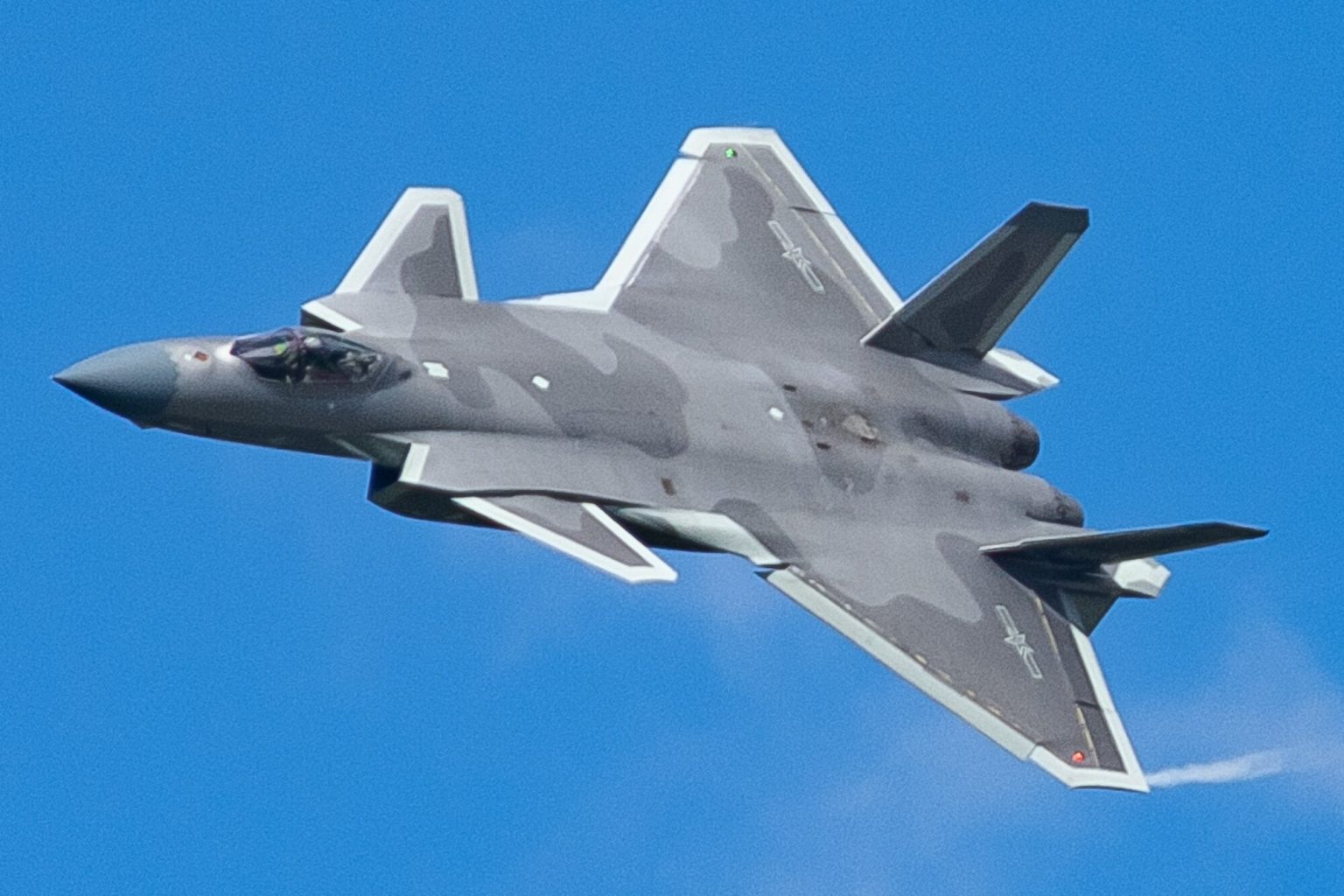
A formation appears on radar screens, then vanishes before operators can confirm what they saw. No warning flare, no clear return signal, just a brief anomaly in the data stream. This is the kind of operating environment the Chengdu J-20 Mighty Dragon was built for.
As China’s first operational fifth-generation stealth fighter, it represents a shift in how the People’s Liberation Army Air Force plans to detect, deter, and dominate modern airspace.
This guide breaks down what the J-20 is, how it was developed, its variants, how it functions, where it is used, and where it is headed next — along with a clear view of its role in shaping next-generation air combat.
At a Glance
| Category: | Details: |
| Type | Fifth-generation stealth air superiority fighter |
| Role | Air superiority, long-range interception, strike support |
| Manufacturer | Chengdu Aircraft Industry Group |
| Operator | People’s Liberation Army Air Force |
| Crew | J-20A: 1 J-20S: 2 |
| First Flight and Service Entry | 2011/2017 |
| Engine | Twin engines (WS-10C in production variants; WS-15 in development) |
| Maximum Speed | Supersonic (reported Mach 2 class) |
| Stealth Features | Low-observable airframe, internal weapons bays |
| Armament | Beyond-visual-range air-to-air missiles, air-to-ground weapons |
| Radar | Active electronically scanned array (AESA) system |
The Chengdu J-20 Mighty Dragon is a fifth-generation, twin-engine stealth fighter operated by the People’s Liberation Army Air Force (PLAAF).
Designed for air superiority and long-range interception, it combines stealth shaping, advanced avionics, and extended-range missile capability to engage targets before being detected.
Rather than focusing primarily on close-range dogfighting, the J-20 was built to support long-range engagements and networked operations aimed at countering advanced Western fighters and expanding China’s air defense reach.
Origins and Development
The J-20 program was led by the Chengdu Aircraft Industry Group, with development beginning in the early 2000s and the first flight achieved in 2011. The aircraft entered operational service in 2017.
Its design reflects lessons from earlier stealth programs worldwide, most commonly the F-22 Raptor, combined with domestic advancements in radar-absorbent materials, sensor fusion, and propulsion development.
Early production models used Russian-derived engines; later variants transitioned to the domestically produced WS-10C.
The higher-thrust WS-15, intended to bring the J-20 closer to F-22-class supercruise performance, has been in development for several years and its production status continues to be updated as the program progresses.
Variants of the J-20
J-20A (Standard Variant)
The baseline J-20 configuration focuses on stealth, long-range detection, and high-speed interception. It is optimized for beyond-visual-range engagements and networked warfare, acting as a key node in China’s integrated air defense system.
J-20B
The J-20B introduces incremental improvements in thrust vectoring capability, avionics processing power, and sensor integration. These upgrades enhance maneuverability and combat responsiveness, particularly in contested air environments.
J-20S
The J-20S adds a second crew member, expanding mission flexibility. This configuration is believed to support roles such as electronic warfare coordination, drone control, and complex strike mission management — reflecting a shift toward manned-unmanned teaming concepts.


How the J-20 Works
Stealth Shaping and Radar Reduction
The J-20 uses angular airframe geometry and internal weapons bays to reduce radar cross-section, minimizing external protrusions to delay detection by enemy radar systems.
Sensor Fusion and Situational Awareness
Onboard systems combine radar, infrared tracking, and electronic intelligence inputs into a unified operational picture. This allows pilots to engage threats without relying on a single sensor source.
Long-Range Engagement Doctrine
The J-20 is designed to detect and engage targets at long distances using advanced missiles and coordinated network data links, reflecting a “first-look, first-shot” tactical philosophy rather than close-range dogfighting.
Strengths
- Stealth-optimized design: The airframe prioritizes low observability, especially from frontal radar exposure, improving survivability in contested airspace.
- Extended range capability: Large internal fuel capacity supports long-endurance missions, ideal for covering vast operational theaters.
- Networked warfare integration: The J-20 is designed to operate within a broader sensor and command network, enhancing battlefield awareness.
Limitations
- Engine performance gaps: Current production variants use the WS-10C, which trails Western fifth-generation powerplants in sustained thrust and efficiency. The WS-15 is intended to close this gap, but its operational timeline remains a moving target.
- Maneuverability trade-offs: Design priorities favor stealth and range over tight dogfighting agility.
- Combat experience: The J-20 has not seen operational combat use. This distinguishes it from Western platforms with extensive real-world deployment records, though it is not unique among fifth-generation fighters globally.
Global Context and Deployment
The J-20 is primarily deployed within China’s air defense and regional deterrence structure under the PLAAF, with an active presence in patrols across the East and South China Sea. It is increasingly integrated into joint exercises and broader air defense networks.
Its presence has prompted upgrades to fifth-generation and advanced fourth-generation fighters among neighboring air forces, while other countries have considered purchasing the aircraft for their fleets.
Future Outlook
The J-20 program is expected to evolve further with improved engines, expanded sensor capabilities, and deeper integration into unmanned systems networks.
Future developments are likely to focus on enhancing thrust performance, increasing stealth efficiency, and enabling more autonomous coordination with drone platforms.
As China continues to expand its aerospace capabilities, the J-20 is positioned not just as a frontline fighter, but as a central node in a broader shift toward networked, multi-domain air warfare.
Source: The Defence Post