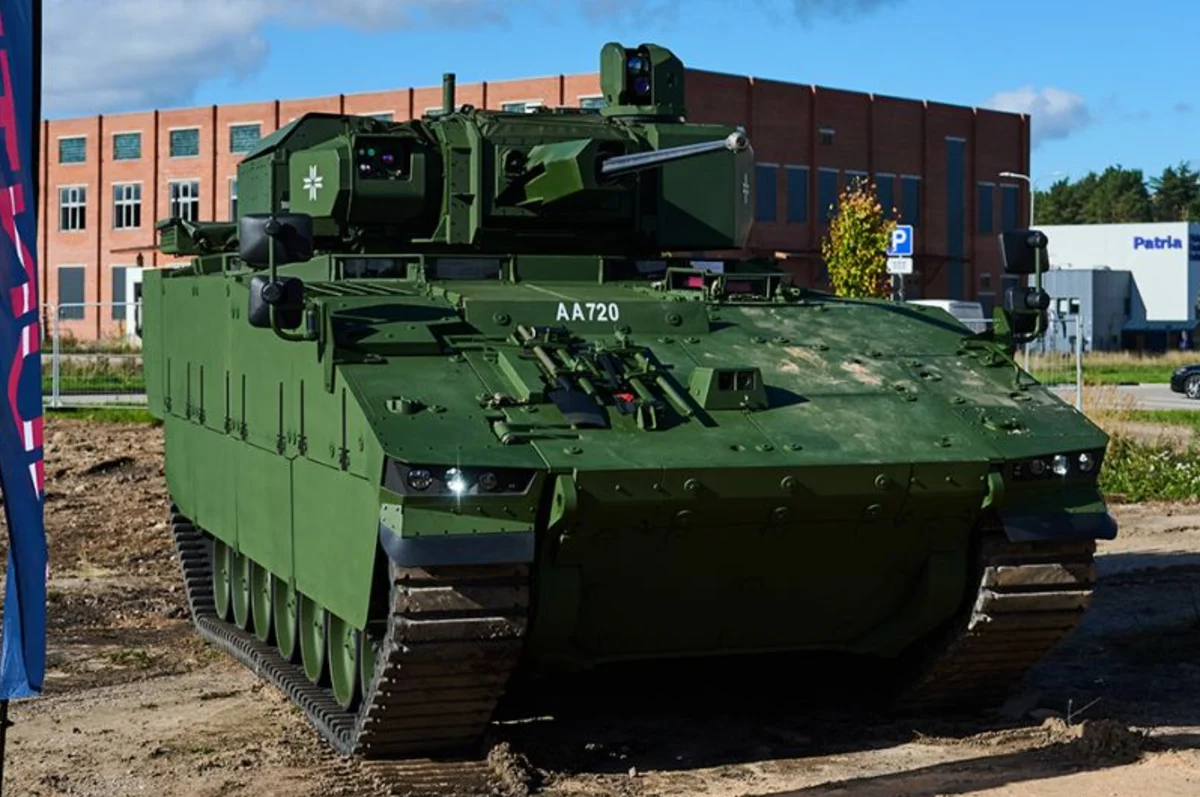
Latvia’s armed forces have taken delivery of their first Hunter infantry fighting vehicle, a tracked armored vehicle based on General Dynamics European Land Systems’ ASCOD design, about 20 months after the country signed its first contract.
The vehicle was handed over on Oct. 7 in the presence of Defense Minister Raivis Melnis, and GDELS said this week that it was ready for delivery a year and a half after the program began. Latvia has ordered 84 Hunters in two batches of 42, signed in January and June 2025, in a program worth almost €800 million (about $929 million). The Latvian Ministry of Defense plans to receive all 84 by 2029. Neither the ministry nor the company has said how many vehicles will be delivered by the end of this year.
The Hunter, called Mednieks in Latvian, is a version of the ASCOD platform built by GDELS-Santa Bárbara Sistemas in Spain and adapted for Latvia. It carries a crew of three and up to six fully equipped soldiers, has armor rated to NATO Level 4, and is armed with an automatic cannon, anti-tank missiles and a machine gun mounted in Elbit Systems’ unmanned UT30 Mk2 turret. Its 1,100-horsepower engine gives it a top speed of about 70 km/h (43 mph) and a range of about 500 km (311 miles). Soldiers of the Latvian Land Forces Mechanized Infantry Brigade, which will operate the vehicle, chose the name.
The Hunters will gradually replace the British-built CVR(T) tracked vehicles Latvia bought secondhand over the past decade.

Final assembly takes place in Latvia. GDELS supplies the vehicle hulls and major components, and Defence Partnership Latvia, a joint venture of Patria Latvia and local firm Unitruck, assembles them at its plant in Valmiera, which also builds Patria 6×6 armored personnel carriers. In June, the first Hunter hull arrived in Latvia to begin local assembly. Latvia signed a separate maintenance subcontract in September 2025 that runs through 2037, and the program requires at least 30% Latvian industrial participation.
GDELS said the program is also moving into counter-drone work. In August, Latvia’s defense ministry tested GDELS counter-drone systems mounted on the Hunter at the Ādaži military base, though no decision on fitting them to the fleet has been announced.
Latvia also joined the international ASCOD user group last year, signing a letter of intent with Spain and Austria, which already operate the vehicle, to cooperate on training, support and upgrades.
The ministry has said the rest of the 84 vehicles will arrive in batches through 2029.
Source: Defence Blog
-

-
-

-

-