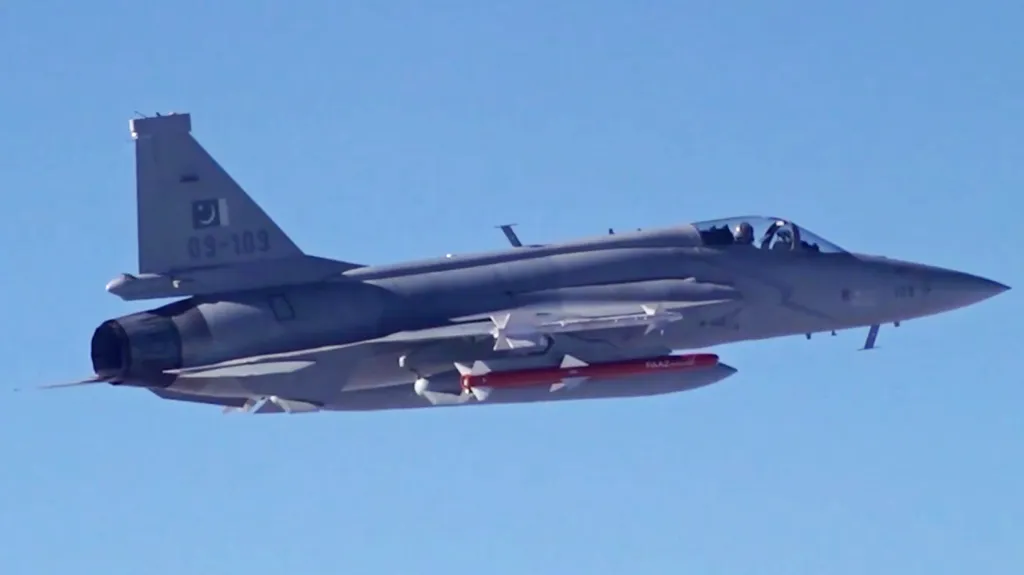
Pakistan conducted the first tests of its own Fa’az air-to-air missile.
The video was published by the country’s Air Force on its X page.
The test launch was carried out from a JF-17 Thunder fighter jet, which was developed jointly with China.
During the tests, a Fa’az-IIR variant equipped with a thermal imaging seeker was used.
The project is being developed by the state-owned company Global Industrial & Defense Solutions (GIDS), which first unveiled mockups of the systems at the IDEF-2023 exhibition in Turkey.
In addition to the thermal imaging version, the developer is also creating the Fa’az-RF variant with an active radar seeker.
Tactical and technical characteristics of the Fa’az
According to the manufacturer’s specifications, both variants have a maximum engagement range of over 100 km and are capable of reaching speeds of up to Mach 3.5.
The target detection range for the radar version is 25 km, while the thermal imaging seeker is capable of acquiring targets at distances of up to 40 km.
Engaging targets at ranges exceeding 100 km with a thermal-imaging missile is achieved using an inertial navigation system and a data link from the carrier aircraft, followed by target acquisition during the terminal phase of flight.
Other air-to-air missiles in Pakistan’s arsenal
To equip its F-16 fighter jets, the Pakistan Air Force uses American AIM-120 AMRAAM medium-range missiles, as well as AIM-9 Sidewinder short-range missiles.
At the same time, to maintain the combat readiness of its Mirage III and Mirage 5 fighter fleet, the Pakistani Air Force continues to operate French Magic 2 missiles.
Pakistan relies primarily on Chinese PL-15E long-range missiles with active radar homing heads for long-range air combat; these are integrated into the armament of the J-10C and JF-17 Block III fighters. In addition, the Pakistani Air Force actively employs Chinese short-range PL-5E II and PL-9C missiles, as well as SD-10 (PL-12) medium-range missiles.
Source: Defence Blog