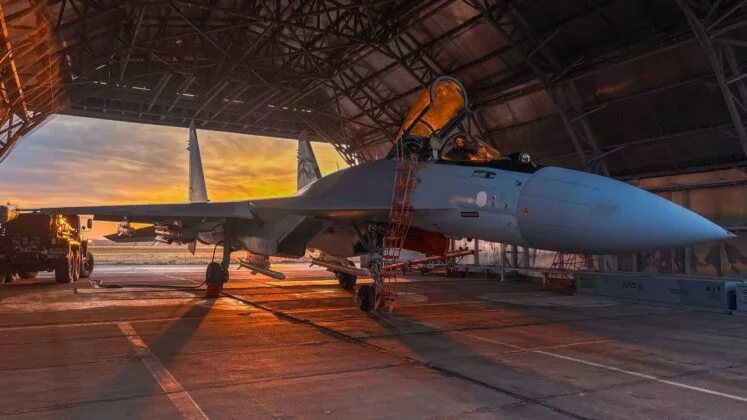
Ukrainian sources say Russia’s defense industry delivered roughly 14 Su‑34 frontline bombers and about 10 Su‑35S fighter jets to its armed forces in 2025, expanding Moscow’s tactical aviation inventory as the war enters its fourth year.
According to those assessments, the new aircraft allow Russia to increase pressure on Ukraine by raising the tempo of guided air‑to‑ground weapon use and strengthening air cover for frontline operations. The Su‑34, manufactured by the Sukhoi Design Bureau and operated by the Russian Aerospace Forces, is a twin‑engine strike aircraft used to launch glide bombs and other precision munitions from standoff distances. The Su‑35S is Russia’s most modern serially produced air‑superiority fighter.
These additions could support more frequent Russian strikes launched from inside Russian airspace, where Ukrainian forces remain restricted from employing partner‑supplied missiles. As noted in early reporting, these constraints have reduced Ukraine’s ability to target Russian airbases, allowing Moscow to sustain aircraft closer to the front.
The context provided by Ukrainian experts highlights a shift in Russian aviation losses during 2025. Earlier in the war, Russian combat aircraft were primarily lost to Ukrainian air defenses or destroyed during attacks on Russian airfields. Open-source monitoring group Oryx previously reported that Ukraine had destroyed “at least 41 Su‑34 and 8 Su‑35S” since the full‑scale invasion began. Most of those losses occurred in the early phases of the war.
However, Ukrainian sources say that in 2025 Russian forces have mainly lost aircraft due to non‑combat causes, including mechanical failures and pilot error. Analysts attribute this to two intersecting factors: Russia’s growing reliance on long‑range guided aviation weapons—which reduces exposure to Ukrainian air defenses—and external restrictions on Ukraine’s use of partner‑supplied missiles against Russian bases. These conditions, they argue, allow Russia to preserve more aircraft from direct Ukrainian fire while revealing internal readiness problems within Russian aviation units.
Russia’s ability to field new Su‑34 and Su‑35S aircraft at this scale suggests that its defense industry maintains capacity to replace losses, though often with simplified or downgraded subsystems due to sanctions. Even so, additional aircraft expand Russia’s potential strike volume and air‑cover capability, particularly along axes where glide bombs have played a decisive battlefield role.
The 2025 deliveries have enabled Russia to intensify its use of guided aircraft munitions against Ukrainian troop concentrations, logistics hubs, and fortified positions. Ukrainian units along several sectors have described continued bombardment by glide bombs launched from Su‑34s beyond the reach of Ukrainian air‑defense systems.
-
-
-
-
-