South Korea has begun deploying its Hyunmoo-5 surface-to-surface ballistic missile to frontline military units, military officials said Sunday, confirming that the country’s most powerful conventional strike weapon has entered operational service as part of efforts to deter North Korea.
According to South Korean military officials, the missile began entering frontline units in late 2025 and is expected to complete full operational deployment before the current administration leaves office in 2030. The Hyunmoo-5 is capable of carrying a conventional warhead weighing up to eight tons, making it the heaviest payload ever fielded on a South Korean missile system.
The Hyunmoo-5 is a South Korean surface-to-surface ballistic missile designed primarily for bunker-buster missions, intended to strike deeply buried underground facilities. While it is officially classified as a short-range ballistic missile (SRBM), its technical characteristics and regional security context allow it to also be categorized as a medium-range or intermediate-range ballistic missile by some analysts.
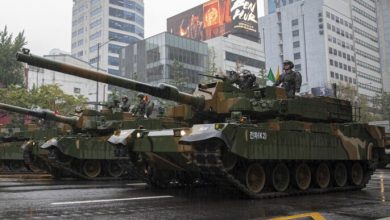
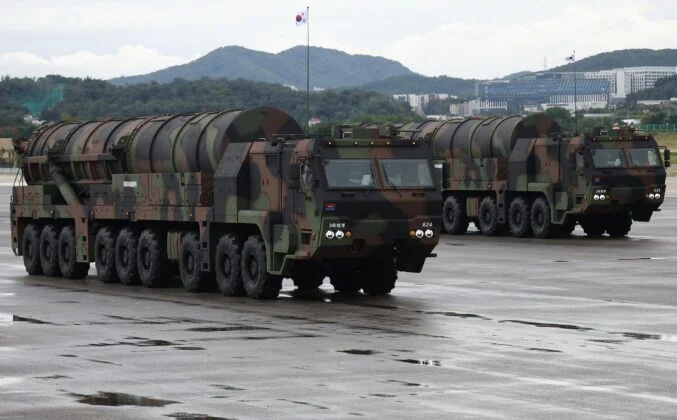
The missile completed final development and testing in 2023, according to South Korean defense sources. It was publicly displayed later that year during Armed Forces Day celebrations and a rare military parade through central Seoul, where it was shown mounted on a transporter-erector-launcher and concealed inside a container. The display came two years after the lifting of U.S.–South Korea missile range restrictions, enabling Seoul to develop longer-range ballistic missiles without treaty limitations.
The Hyunmoo-5 is designed to target hardened command bunkers and strategic facilities believed to be used by North Korea’s leadership and missile forces. Its large conventional warhead is intended to destroy or disable underground structures that are difficult to reach with air-delivered munitions.
Lee Il-woo, director of the Korea Defense Network, said the Hyunmoo-5 represents the most powerful missile deployed within South Korea’s Hyunmoo series.
“The Hyunmoo-5 carries an extremely high-yield conventional warhead, and by reducing payload it could theoretically extend its range to around 3,000 kilometers, with some even comparing it to an intercontinental-class missile,” Lee said. “In terms of sheer power and strategic signaling, it is the strongest missile South Korea has fielded.”
From North Korea’s perspective, Lee said the missile poses a serious challenge due to limited interception capability.
“The likelihood of North Korea successfully intercepting the Hyunmoo-5 appears very low,” he said, citing the mixed real-world performance of Russian-made S-300 and S-400 air defense systems, which are similar to those operated by Pyongyang.
However, Lee cautioned that even the Hyunmoo-5 faces physical limits when targeting deeply buried facilities. Many of North Korea’s strategic sites are located more than 100 meters underground beneath granite bedrock, which complicates penetration by conventional weapons.
“Even the most advanced conventional bunker-buster weapons struggle in granite terrain,” Lee said. He cited U.S. use of the GBU-57 massive ordnance penetrator, which is estimated to penetrate around 60 meters in softer rock such as sandstone. “North Korea’s facilities are deeper — often 100 to 150 meters — and built under much harder geological conditions.”
“As a result, it is unrealistic to say that conventional weapons alone, including the Hyunmoo-5, can fully destroy those facilities. Without nuclear weapons, complete penetration is not feasible,” he added.
South Korea’s military has integrated the Hyunmoo-5 into its Korea Massive Punishment and Retaliation (KMPR) doctrine, one of three pillars of its deterrence strategy alongside the Kill Chain preemptive strike concept and the Korea Air and Missile Defense system. The missile is intended to provide a conventional option for retaliatory strikes against high-value targets in the event of conflict.
South Korea is also pursuing follow-on systems informally known as the Hyunmoo-6 and Hyunmoo-7, which are expected to focus on extended range or improved penetration, though no official details have been released.