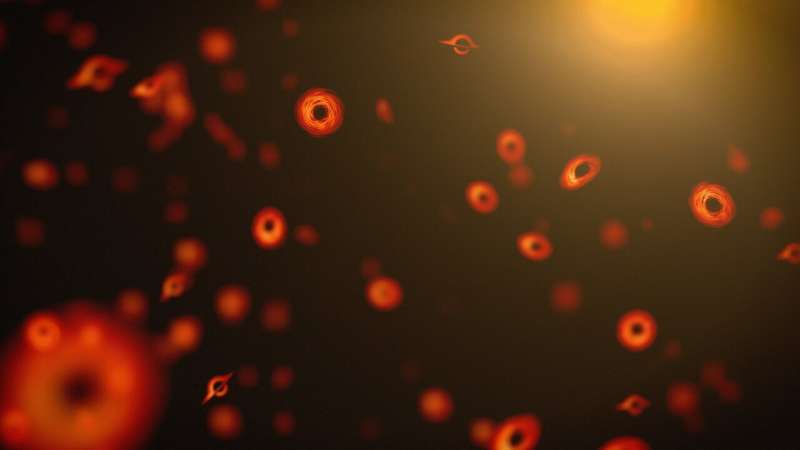
Primordial black holes (PBHs) don’t exist as far as we know. But if they did, these hypothetical objects would have formed in the early universe rather than from dying stars, and they may even make up dark matter. That’s not the end of the weirdness. Their formation could have been even stranger if it occurred in a universe with a dark dimension, which is another theoretical construct. It posits that our space includes a hidden extra spatial dimension.
In this world of ifs and buts, a paper published in the journal Physical Review D explores how primordial black holes would form and survive in such a universe.
Enter the dark dimension
According to standard cosmology, our universe operates in four dimensions: three spatial dimensions (length, height and breadth) and one time dimension. But in the dark dimension scenario, a hidden extra spatial dimension is thrown into the mix.
It is believed to be roughly a micron wide and is hidden from view. While ordinary matter and forces are trapped in our standard four-dimensional space, gravity can extend into that extra dimension. Because primordial black holes can be extremely small, this dark dimension could have changed how they formed and survived.
So how could scientists investigate such a strange possibility? The answer did not come from observations but from extensive theoretical math and physics by a team led by Luis Anchordoqui of Lehman College in the U.S. They applied proposed rules of quantum gravity to see how black holes would behave under the dark dimension theory. The researchers also tested whether these objects would function as standard four-dimensional entities or as five-dimensional ones.
“In this paper, we revisit the formation mechanisms of PBHs and ask whether, within the dark dimension scenario, PBHs are effectively 4D or 5D black holes,” the study authors wrote.
From four dimensions to five
Their numbers revealed a rather strange picture. Some primordial black holes would start out behaving like standard four-dimensional objects. But they would then become unstable and transform into five-dimensional ones. Others formed from cosmic strings would be five-dimensional from the start.
As far as their survival is concerned, the extra dimension changes how long they could stick around. “We further show that PBHs formed from cosmic strings can have lifetimes comparable to the age of the universe.”
While the research connects two mysteries into one bigger one, it still leaves us waiting for real-world proof. But if either is real, it could give us details about the high-energy physics of the early universe.
Source: Phys