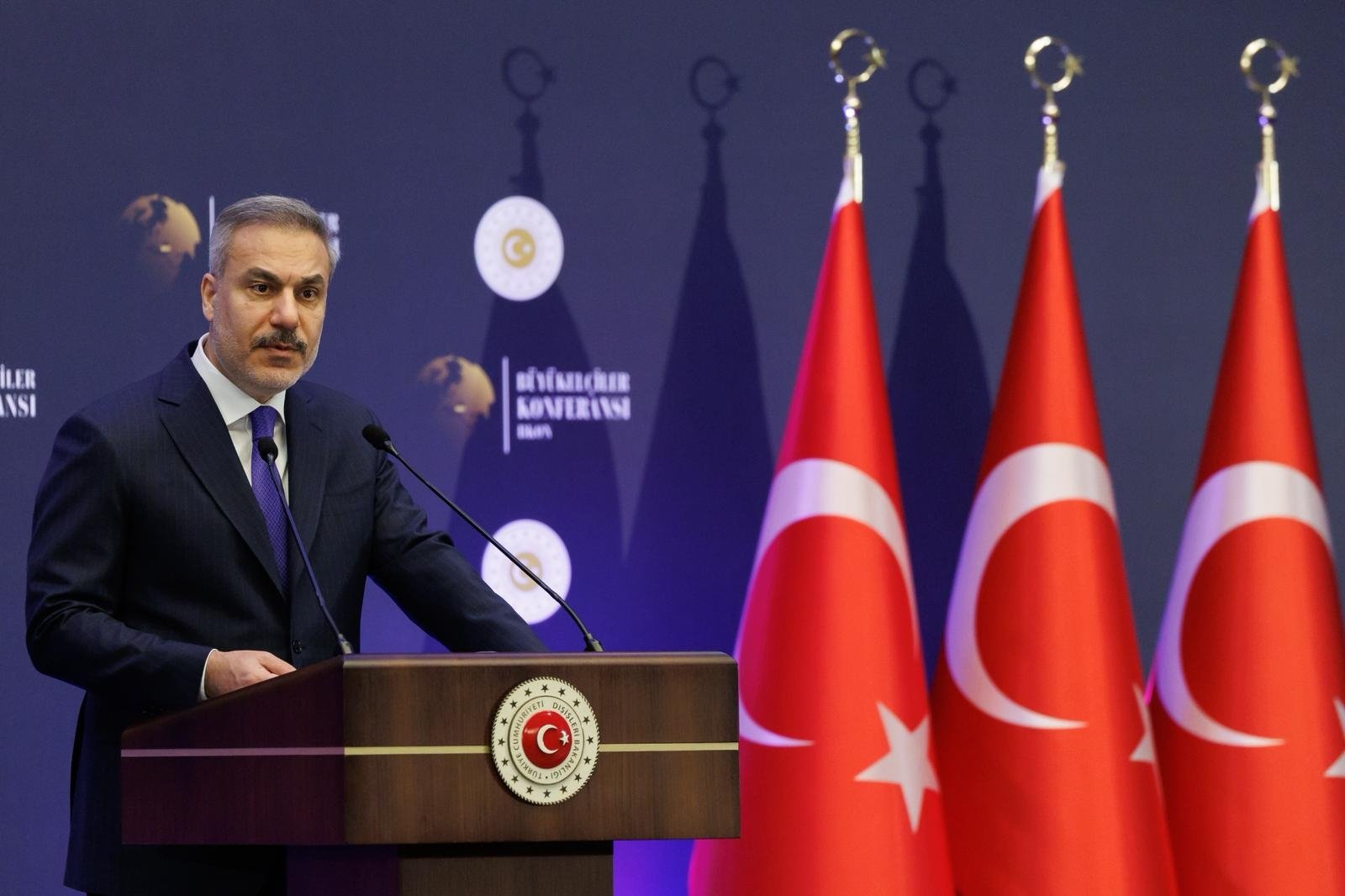
The Turkish foreign minister on Thursday urged the YPG, the Syrian wing of the PKK terrorist group backed by the U.S., to adhere to an integration deal with Damascus quickly or face military ops like Türkiye launched in the past
Amid reports that Türkiye is considering an end-of-year deadline for the U.S.-backed terrorist group YPG to integrate into Syrian government forces, Hakan Fidan told an interview on Thursday that “patience is wearing thin.”
“They should comply with the deal. We don’t favor resorting to military force, but patience of relevant actors is running out,” Fidan told TRT World. “We hope the integration issue between the YPG and Damascus will be resolved through dialogue,” he added.
The YPG, which controls a self-styled autonomous region in northeastern Syria, signed a deal with the post-Assad administration in Damascus on March 10. The deal stipulates integrating the YPG forces into the new Syrian army. Yet, the YPG appears unwilling to adhere to the deal and floats the idea of decentralization for Syria’s Kurds.
The YPG’s integration is a matter that may help Türkiye stave off security risks from neighboring Syria. Türkiye carried out cross-border operations during the Syrian civil war to liberate areas near the Turkish border from YPG domination. The operations helped the Syrian opposition regain control in most of northern Syria and curbed YPG attacks targeting Turkish border towns.
In the post-Assad era, the YPG, which enjoyed U.S. support under the guise of a joint fight against the terrorist group Daesh, aspires to keep control of its so-called “Rojava autonomous administration,” while the new administration in Damascus strives to build a united Syria.
Fidan said on Thursday that Daesh was indeed a major threat, but regional countries, especially Türkiye and Syria, can tackle the issue effectively through a good cooperation mechanism. He pointed out that Türkiye was experienced in counterterrorism, due to its fight against the PKK and other terrorist groups in the past decades and developed comprehensive skills in this area. He said Daesh carved a way for itself in Syria due to the threatening environment in that country during the civil war.
“We held talks with regional countries earlier this year and urged international and regional cooperation for the recovery of Syria and preventing hostile elements from exploiting the current situation in the country,” he said. “We should never allow any terrorist elements to derail Syria from the path to recovery,” he said.
The minister complained about the pace of implementation of the March 10 deal. “We agree with Syria and our partners on the view that the YPG was trying to buy time. I think they hope that an opportunity will arise (to not honor the deal); they may hope for a regional crisis, and this might be tied to Israel’s expansionist policies towards Syria and other places,” he stated. He hailed the fact that “our American partners are aware that this process should be completed.” Head of U.S. Central Command (CENTCOM) Adm. Brad Cooper said last week that the YPG’s integration with the Syrian army was essential to create a more predictable and stable security environment.
“Every armed group except the YPG integrated into the Syrian Defense Ministry. This is crucial for national unity because no state can have armed groups loyal to authorities other than (the central) state,” Fidan said. “We don’t want the YPG to deviate from the path. This deal should be implemented without delay. I am optimistic and believe that we can achieve this goal through the right tactics and cooperation,” he said.
Second phase in Gaza
On Türkiye’s efforts for the recovery of Gaza and cease-fire, Fidan said Türkiye was pressing for the second phase of the cease-fire agreement to start as Israel’s violations continue to mount, warning that renewed violence could spread beyond the enclave while stressing Türkiye’s readiness to contribute to international stabilization efforts.
He said the cease-fire was “very much precious for us because we’ve seen the horror, the human tragedy, the genocide that took place in Gaza over the last two years,” since the fall of 2023. But he added that, “There are constant violations of (the) cease-fire,” noting that, “Since the (Oct. 10) declaration of the cease-fire, almost 400 Palestinians have been killed.”
Fidan said Türkiye supports moving the deal to its second phase, which includes a planned international stabilization force and a governance mechanism for Gaza. “Over the next couple of weeks, we will see some preliminary clear results of those discussions.” He said Türkiye is ready to take part in such a force, despite Israeli objections, arguing that Ankara has acted as “the voice of the human conscience, the international conscience in the face of the Israeli atrocities in Palestine.”
A U.N. Security Council resolution adopted on Nov. 17 authorized a “Board of Peace” and countries working with it to establish the International Stabilization Force (ISF).
Risk from Russia-Ukraine war
Turning to the Russia-Ukraine war, Fidan said Türkiye supports ongoing mediation efforts led by the U.S. and believes the parties are “very close to reaching a deal now,” adding that any agreement would ultimately need public legitimacy in Ukraine.
He also reiterated that maritime security in the Black Sea remains critical, warning that escalating attacks risk wider regional instability.
Citing Türkiye’s role in brokering the 2022 Black Sea grain deal, which enabled the exports of about 30 million tons of grain, mainly to Africa, he stressed that maritime security remains critical for global food supplies.
“The shortest way to put an end to all these problems is to reach a cease-fire,” he said, warning that continued escalation could spread to other parts of Europe.
Source: Daily Sabah