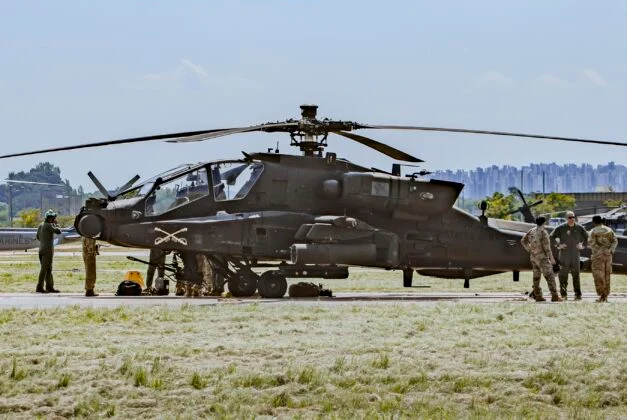
A United States Army reconnaissance and attack helicopter squadron stationed in South Korea was deactivated last month as part of a service-wide transformation effort, according to a congressional report released Thursday.
The U.S. Army deactivated the 5th Air Cavalry Squadron, 17th Cavalry Regiment (5-17 ACS) at Camp Humphreys on Dec. 15, according to a recent report by the Congressional Research Service, citing Army information. The unit had been deployed to South Korea since May 2022 in support of the 2nd Infantry Division.
The 5-17 ACS operated AH-64 Apache attack helicopters and reconnaissance assets and was based at Camp Humphreys in Pyeongtaek, about 60 kilometers south of Seoul. The CRS report said the deactivation was conducted under an Army transformation initiative, without detailing whether the move involved permanent force reductions on the Korean Peninsula.
The development drew attention amid speculation that Washington could consider adjustments to its force posture in South Korea, where about 28,500 U.S. troops are stationed under U.S. Forces Korea (USFK). Some observers have linked the move to broader discussions about countering regional challenges, including China’s expanding military presence.
A U.S. Department of War official told Yonhap on Friday that no final decision had been made regarding the fate of the squadron. “No decision has been made yet, and we do not comment on force structure matters that precede a decision,” the official said, suggesting the situation remains under review.
South Korea’s defense ministry also sought to calm concerns that the unit’s suspension signaled a reduction in U.S. troop levels. Defense Minister Ahn Gyu-back said the move should not be interpreted as a drawdown of USFK.
“I do not think that is the case,” Ahn told reporters when asked whether the change indicated a reduction from the current USFK strength. He said the adjustment appears linked to broader changes within the U.S. Army rather than a Korea-specific decision.
“There seem to be a number of changes underway within the U.S. Army related to Apache helicopters,” Ahn said. “This does not appear to be an issue limited to U.S. Forces in Korea, but rather part of reforms taking place across the U.S. Army as a whole.”
The AH-64 Apache is the U.S. Army’s primary attack helicopter, used for close air support, armed reconnaissance, and deep strike missions. Apache units have long played a role in U.S. deterrence posture on the Korean Peninsula, where they are integrated into combined planning with South Korean forces.
Ahn said he plans to visit Camp Humphreys on Jan. 6 to seek clarification directly from U.S. military officials. “I intend to hear firsthand about the circumstances surrounding this decision,” he said. “It would not be appropriate to draw conclusions based on speculation alone.”
The U.S. Army has been restructuring aviation units as part of a broader modernization effort, including changes to reconnaissance and attack helicopter formations. The CRS report did not indicate whether the capabilities previously provided by the 5-17 ACS would be replaced by other units or assets.
-

-
-
-
-