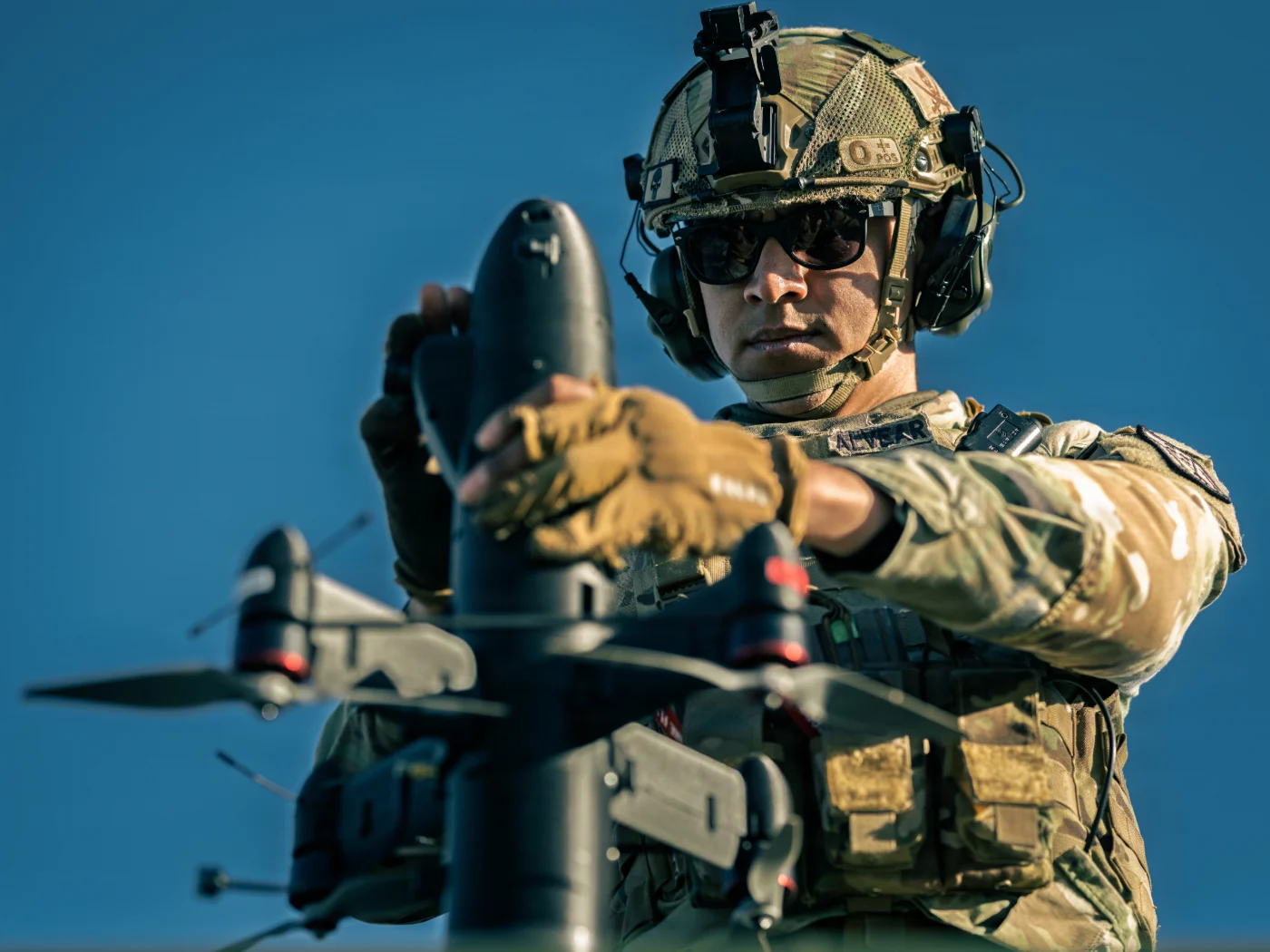
U.S. Army air defense soldiers in Poland spent five days learning to fly FD-1 interceptor drones into incoming targets over the Baltic Sea, as the Army looks for cheaper ways to stop large waves of enemy drones.
The training, called Operation Audacious Fury, ran November 2–6 at the Ustka Training Area on Poland’s northern coast, the U.S. Army said.
The assessment was led by the Tactics, Integration and Employment Battery of the 5th Battalion, 4th Air Defense Artillery Regiment, part of the 52nd Air Defense Artillery Brigade and the divisional air defense battalion for U.S. Army Europe and Africa. Its goal was to build a deeper stock of low-cost, short-range interceptors against Group 1 to 3 drones, the small and mid-size unmanned aircraft that range from quadcopters to larger fixed-wing models, including when they come in large numbers.
“There are a lot of systems that we can use to get after defeating the massed UAS threats while staying on the right side of the cost-curve, so we don’t expend our exquisite munitions ineffectively,” said Lt. Col. John Verwiel, the battalion commander.
The FD-1 is a first-person-view interceptor drone built by Mountain Horse Solutions, a Global Ordnance company. A single operator flies it into an enemy drone, and the company says it can be set up and airborne in under two minutes, either on its own or cued by existing radars and sensors. A human operator authorizes every engagement. The Army placed a second order for the FD-1 in October through the Global Tactical Edge Acquisition Directorate, following a first order in spring 2026, Soldier Systems Daily reported. The quantities and contract values have not been made public.
The battery is writing the tactics and the certification steps needed to turn a soldier with no drone experience into a qualified FPV interceptor pilot.
“We came out here to develop the TTPs and our training tabling certification system to get an operator with no knowledge or skills in flying an FPV drone to become a skilled operator,” said Staff Sgt. Felix Aguilar, a platoon sergeant with the battery.
Verwiel said the next step is to spread the approach across the force.
“What I want to do is standardize the training for it, standardize the engagement process, and then get it out to the force at scale to defeat that mass problem,” he said.
The battalion’s main weapon is the M-SHORAD, a Stryker armored vehicle armed with Stinger missiles, a 30 mm cannon and a machine gun, also known as the Sgt Stout. Aguilar said his soldiers, trained as air and missile defense crew members for that vehicle, never expected to be flying drones.
“None of my Soldiers thought they would be flying drones when they enlisted as an Air and Missile Defense Crewmember … [and] now they’ve certified on the SGT Stout and are flying drones into the Baltic Sea,” he said.
The Army has been testing several low-cost drone interceptors, including the IonStrike drone interceptor, after watching Ukraine use cheap FPV and interceptor drones against Russian Shaheds and reconnaissance drones. Units in Europe have also stood up small, mobile counter-drone teams, as when the U.S. Army fielded Ukraine-inspired mobile fire teams to counter drones.
Source: Defence blog
-
-
-
-
-