Raytheon has won a U.S. Navy agreement to move its design for the Nuclear-Armed Sea-Launched Cruise Missile, or SLCM-N, out of early concept work and into a focused development phase, the company said Nov. 24.
The deal is an Other Transaction Authority agreement, a contracting route the Pentagon uses for prototype work. Under it, Raytheon’s Advanced Technology team will “mature the system’s design, integrate key subsystems and prepare for future prototype demonstrations,” according to a company release. Anduril Rocket Motor Systems, Divergent and Williams International will contribute to the work.
Raytheon didn’t disclose the agreement’s value, when it was signed or how long it runs. The release doesn’t say how many prototypes the U.S. Navy wants or what each partner will build. It also doesn’t say whether competing teams moved forward under similar agreements.
“This contract reflects the critical importance of strengthening our nation’s deterrence and expanding the options available to respond to emerging threats,” said Colin Whelan, president of Advanced Technology at Raytheon.
The U.S. Navy said in October that it had signed five SLCM-N prototype agreements worth $743.6 million on Sept. 23, with work running through Dec. 31, 2027, as reported at the time. Leidos subsidiary Dynetics, Raytheon and Northrop Grumman got the missile development and systems integration work. Northrop Grumman Mission Systems and Pacific Engineering took launch canisters. Individual values weren’t broken out, and Raytheon’s release doesn’t say whether its new agreement is the one signed in September.
Raytheon says it will lean on what it calls its “composable weapons” approach. The release describes that as “mature, modular building blocks” that can be put into new systems “to reduce cycle time and accelerate missile development.”
The fiscal 2024 defense authorization act requires initial operational capability by Sept. 30, 2034. Fiscal 2026 legislation goes further: it requires a limited number of weapons to be ready for a limited operational deployment by September 2032, according to the Congressional Research Service. Those are deadlines in law, not proof the program will meet them.
Williams International builds the small turbofan engines that power the Tomahawk family. Anduril Rocket Motor Systems makes solid rocket motors, and Divergent is known for additively manufactured structures.
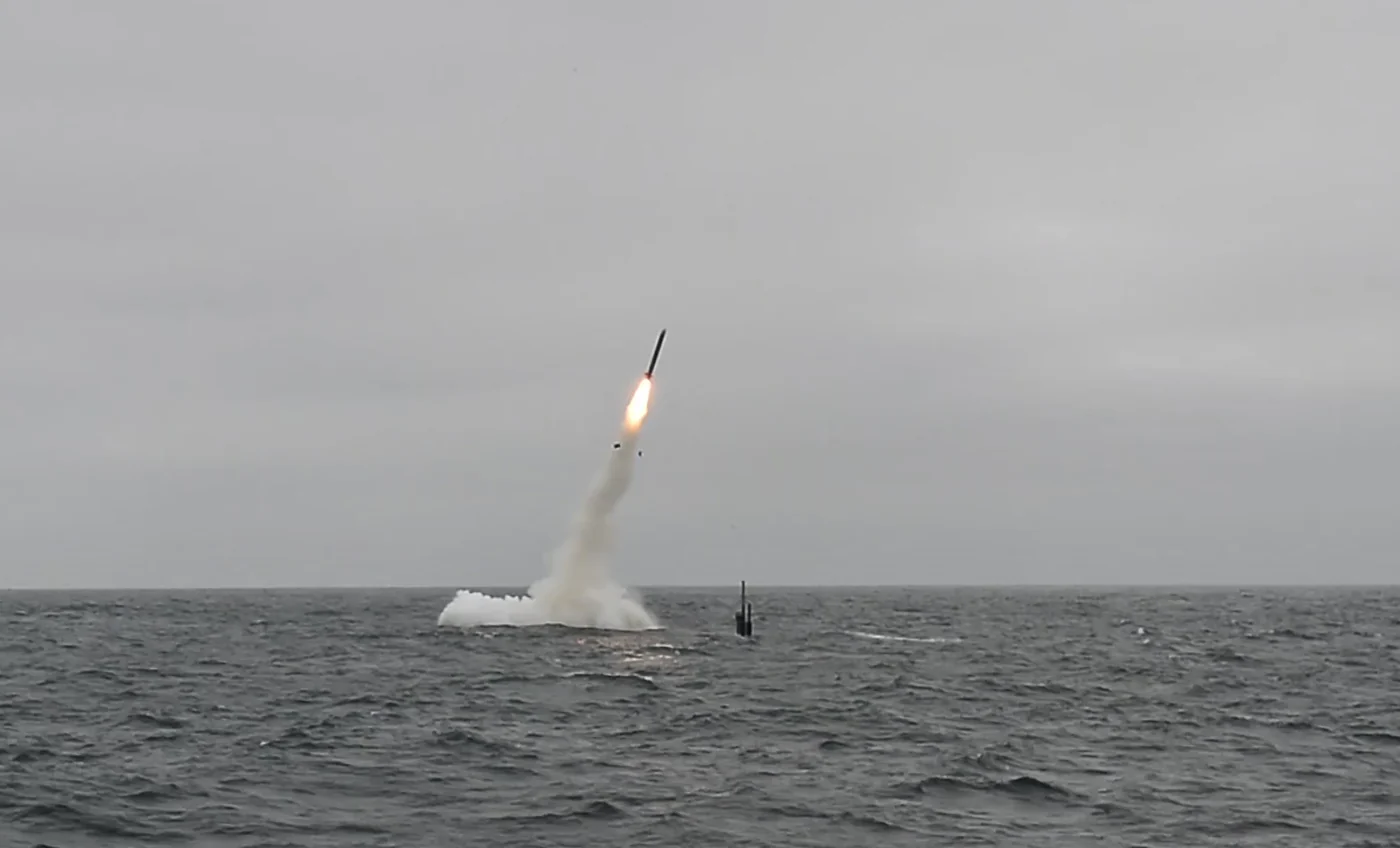
For comparison, a submarine-launched Tomahawk leaves its tube, and a solid-fuel booster fires to carry it out of the water and into the air. The booster then drops away, the wings unfold, and a turbofan takes over for the long cruise to the target. Raytheon hasn’t said whether SLCM-N will follow the same sequence, and the company gave no range, speed or size figures.
The missile is being developed for Virginia-class attack submarines fitted with the Virginia Payload Module, according to the Navy’s Strategic Systems Programs office, which awarded launcher and canister work in September 2025. The launcher subsystem will connect the missile to the submarine’s systems through a Virginia Payload Tube. SLCM-N is also expected to arm the planned Trump-class battleships.
Sandia National Laboratories said in January 2026 that the missile would carry a new W80-5 warhead variant, as The Defence Blog noted earlier. The W80 family goes back to the warhead on the original nuclear Tomahawk.
That weapon, TLAM-N, went to sea aboard U.S. surface ships and submarines in the mid-1980s. It came off ships in the early 1990s, and its retirement was completed in 2013. The first Trump administration revived the idea of a nuclear sea-launched cruise missile in its 2018 Nuclear Posture Review.
In its fiscal 2023 budget request, the U.S. Navy called the program “cost prohibitive” and said the schedule “would have delivered capability late to need.” Congress kept funding the missile and in 2023 wrote the 2034 deadline into law.
The current competition began in August 2025, when the Navy picked five firms for initial flight system design: Leidos, Raytheon, Lockheed Martin, Northrop Grumman and Florida Turbine Technologies. Lockheed Martin wasn’t among the missile teams named in September 2026.
Other pieces of the system are moving too. General Dynamics Mission Systems won a $194.1 million modification in September for fire control engineering. JRC Integrated Systems got $47.4 million for engineering and technical support.
Budget legislation passed in 2025 set aside $2 billion to speed up missile development and $400 million for the warhead, according to the Congressional Research Service. SLCM-N wasn’t in the White House’s fiscal 2027 budget request. Brandon Williams, head of the National Nuclear Security Administration, said in April that it has administration support and will be in the fiscal 2028 request.
Raytheon says the next step is prototype demonstrations, with no dates attached. “Building on decades of experience developing cruise missiles, we’re applying our proven design, integration and test expertise to rapidly field a highly reliable capability that our nation can trust when it matters most,” Whelan said.
Source: Defence Blog
-

-
-
-
-