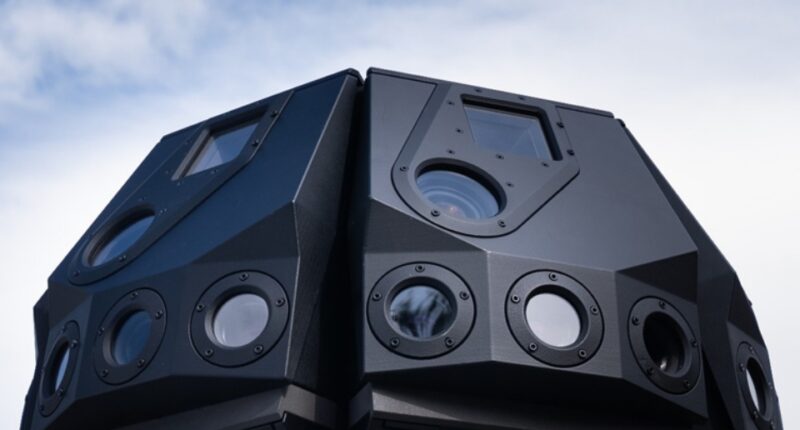
British Army fields passive drone detection technology capable of identifying unmanned aircraft from five kilometers away.
The UK has deployed its first passive counter-drone detection system at a British Army base, with two domestic companies delivering the capability in under six months.
Known as Project Halo Shield, the system recorded 29 drone alerts during its first 17 days of live monitoring at Warminster Garrison.
Detections were recorded at distances of up to 5 kilometers (3.1 miles), although none of the drones posed a threat to the base.
The British Army also flew its own drones against the system to expose potential gaps and weaknesses.
Early results are informing plans to deploy passive drone detection capabilities across other UK military sites.
Layered Detection
Funded by UK Defence Innovation, Project Halo Shield combines radio-frequency and optical detection technologies supplied by Dedrone and Quell.
Dedrone, now part of Axon, contributed command-and-control software that fuses data from multiple sensors into a single operational picture.
Three radio-frequency sensors triangulate a drone’s position across the garrison, while a fourth identifies the aircraft and its controller by detecting signals exchanged between them.
Edinburgh-based Quell supplied SkySpyke as the system’s second layer. The autonomous optical platform provides hemispheric coverage while detecting, tracking, and identifying airborne objects.
Its AI software filters detections and provides alerts and visual confirmation of objects of interest, reducing the burden on operators.
Wider Deployment Planned
Feedback from the British Army’s Experimentation and Trials Group (ETG) will guide the system’s further development.
Future deployments could add radar and acoustic sensors to the existing radio-frequency and optical layers, creating a broader detection network across UK garrisons.
“Working with UKDI and industry on this kind of dual use capability has been beneficial to all parties, making the British Army more safe from real, modern, threats while in its barracks,” ETG Col. James Howard said.
Aource: Drone Front
-
-
-
-

-