
Breaking Down the Zumwalt-Class Destroyer: The US Navy’s Stealth Warship
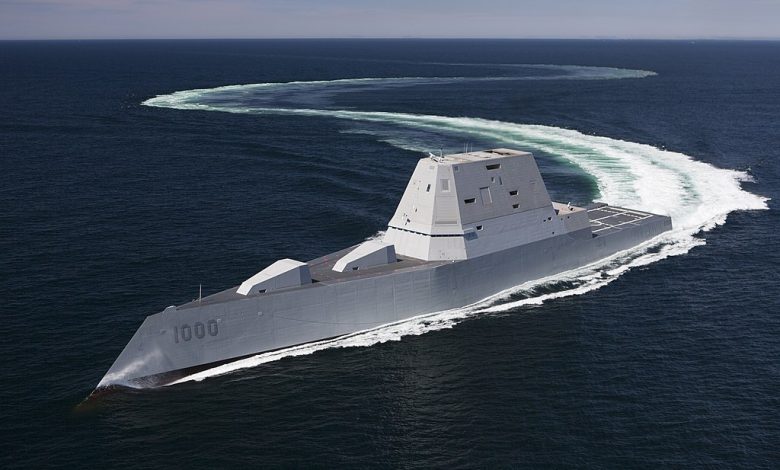
When the US Navy first unveiled the Zumwalt-class destroyer, also known as the DDG-1000, its sharp angles and futuristic profile appeared more like something from science fiction than a warship. But beneath its stealthy exterior lies one of the most advanced surface combatants ever built.
The stealth destroyer is designed with a unique wave-piercing hull and an advanced integrated power system, effectively combining stealth and heavy firepower.
First commissioned in 2016, the ship features reduced radar visibility, powerful sensors, and the capacity to host next-generation weapons to secure naval dominance.
This guide explores what the Zumwalt is, how it works, and why it matters for US naval power.

Inside the Zumwalt’s Systems and Design
The Zumwalt class features a tumblehome hull design that slopes inward, dramatically reducing its radar cross-section and making the massive 600-foot (182-meter) destroyer appear on radar like a much smaller vessel.
Its integrated power system produces 78 megawatts of electricity, far more than current destroyers and enough to operate advanced radars, electronic systems, and potentially future weapons such as railguns or high-energy lasers.
The ships were originally equipped with two Advanced Gun Systems designed to fire Long Range Land Attack Projectiles over 60 miles (96 kilometers). The intended ammunition was canceled due to costs exceeding $800,000 per round, leaving the guns without usable shells.
As a result, the US Navy has repurposed the ships to carry conventional and hypersonic missiles, including the Conventional Prompt Strike system.
The Price of Stealth
The Zumwalt-class destroyer quickly became known as one of the most expensive warship programs in US Navy history.
Originally conceived as a fleet of more than 30 ships, the program was repeatedly scaled back as costs rose. Each ship is estimated to cost around $7.5 to 8 billion, including research and development, compared to approximately $2 billion for a modern Arleigh Burke-class destroyer.
Even the flyaway cost of roughly $4 billion per hull far exceeded initial expectations.
With only three ships ultimately built — USS Zumwalt (DDG-1000), USS Michael Monsoor (DDG-1001), and USS Lyndon B. Johnson (DDG-1002) — the program stands as a cautionary tale of ambitious design and spiraling budgets.
Critics argue that the navy invested billions in ships whose primary weapon systems were rendered useless when the specialized ammunition program was canceled due to its exorbitant cost.
However, others view the Zumwalt as an expensive yet valuable testbed, paving the way for integrated power systems and future weapons.

Upgrades Versus Limitations
Since commissioning, the Zumwalt-class has undergone significant reorientation.
Originally built around two Advanced Gun Systems (AGS) designed for long-range precision strike, the US Navy shifted focus toward leveraging the ship’s integrated power system and stealth design for future weapons.
Plans now include arming the destroyers with hypersonic missiles, which could make them among the most formidable surface combatants in the world. However, despite these advances, Zumwalt’s limitations are stark:
- Cost overruns: With development and procurement expenses, each ship cost over $7 billion, making them the most expensive destroyers ever built.
- Canceled weapons: The AGS lost its ammunition, eliminating the ship’s original land-attack role.
- Fleet size: Initially planned at 32 ships, the program was reduced to three due to escalating costs and shifting priorities.
- Maintenance complexity: The cutting-edge systems and unique design features of these systems made upkeep more challenging compared to the well-established Arleigh Burke-class destroyers.
Impact on US Defense and Global Naval Strategy
Despite its problems, the program has influenced both the US Navy and global naval development in several ways:
- Technology pathfinder: The class has served as a platform to test integrated electric propulsion, automation systems that reduce crew size, and advanced radar. These technologies inform the design of the US Navy’s future destroyer program, DDG(X).
- Shift in mission: With the AGS rendered obsolete, the Zumwalt-class destroyers are being modified to carry hypersonic missiles, transforming them into strike platforms that align with the US Navy’s strategy for deterring peer competitors, such as China and Russia.
- Symbol of risk and innovation: Globally, the Zumwalt program illustrates both the potential and pitfalls of leap-ahead defense projects. While its radical design drew international attention, other navies have largely stuck to incremental destroyer upgrades rather than replicating the US approach.
- Industrial lessons: The cost and scope challenges of Zumwalt influenced US naval procurement strategy, reinforcing the need to balance innovation with affordability and scalability.