
India Bets on Home-Grown Air Defense System Over NASAMS
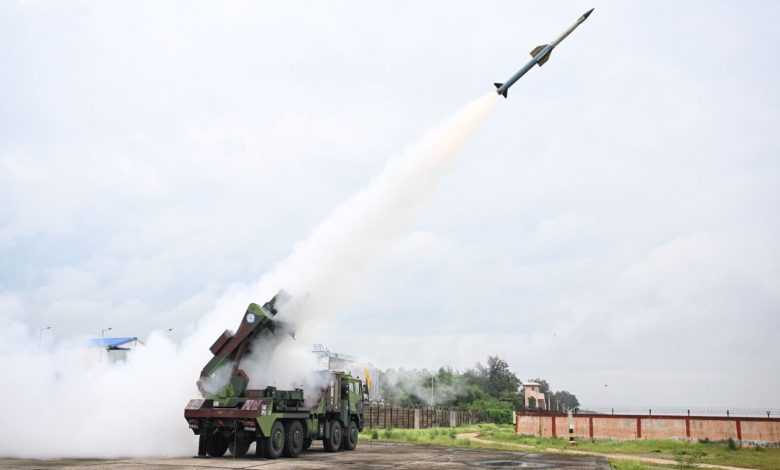
India is moving toward the deployment of its home-grown integrated air defense system to strengthen protection over the national capital region.
The move follows the multilayered Integrated Air Defence Weapon System (IADWS) completing its first flight test in August.
Long in the making, the project’s reported advancement comes against the backdrop of India-Pakistan conflict in May, when a Pakistani Fatah-II guided rocket artillery projectile was intercepted roughly 250 kilometers (155 miles) from Delhi.
The development also indicates that India is moving on from considering the National Advanced Surface-to-Air Missile System (NASAMS) II for the role, as the US-Swedish system is viewed as too expensive, according to Asian News International.
Talks to acquire NASAMS II — which protects Washington, DC — had progressed earlier, and the US State Department approved a possible $1.9-billion sale in 2020.
Integrated Air Defence Weapon System
Developed by the Defence Research and Development Organisation, the system integrates indigenous Quick Reaction Surface-to-Air Missiles (QRSAM), Advanced Very Short Range Air Defence System (VSHORADS), and a high-power, laser-based directed energy weapon (DEW).
Its operations are coordinated through a centralized command-and-control center developed by the Defence Research and Development Laboratory.
The QRSAM offers a 120-kilometer (75-mile) surveillance range, supports target tracking out to 80 kilometers (50 miles), and can engage up to six incoming targets simultaneously at distances of up to 30 kilometers (19 miles).
The missile is equipped with a radio-frequency seeker and incorporates advanced electronic counter-countermeasures to resist jamming.
Meanwhile, the portable VSHORADS is designed for anti-aircraft engagements and the neutralization of low-altitude aerial threats at short ranges.
It has an effective range of around 6 kilometers (3.7 miles) and a maximum engagement altitude of approximately 3 kilometers (1.8 miles).
Earlier this year, DRDO also tested its Mk-II (A) DEW, developed to disable unmanned aerial vehicles and small fixed-wing aircraft.
The organization is further pursuing a 300-kilowatt laser weapon, known as Surya, with a demonstration planned for 2027.