
Australia completes M1A1 tank transfer to Ukraine
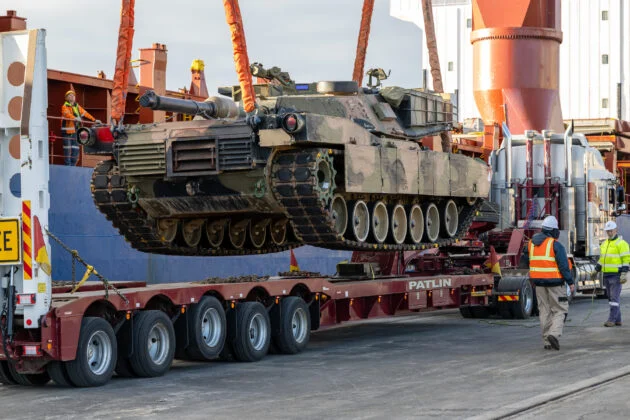
A convoy of Australian M1A1 Abrams tanks has arrived at a classified location in Poland, marking the final stage of a tightly controlled operation to deliver the armored vehicles to Ukraine, which remains at war with Russia.
The Australian Defence Force granted ABC News exclusive access to the operation after the mission was completed, lifting weeks of secrecy surrounding the final shipment of tanks. The vehicles are part of Australia’s pledge to donate 49 retired M1A1 Abrams tanks to Ukraine. While the donation itself has been public since 2024, the logistics behind moving the tanks halfway across the world have remained undisclosed until now.
The final dozen tanks began their journey in October, when they were loaded onto a dedicated cargo ship in Geelong, Victoria. Five Australian Defence Force personnel accompanied the shipment on a 55-day sea voyage to the Northern Hemisphere.
Lance Corporal Jordan Upton, 24, who took part in the transit, described the experience.
“I was a bit overwhelmed, honestly, at the fact of like being at sea for like the long duration we were, for 55 days,” Upton said. “It was kind of scary. I’d never experienced a trip like that, especially on a commercial cargo vessel as well.”
“But now being here, I’m pretty proud that we were able to achieve it and yeah, I’m excited to get these tanks to Ukraine,” he added.
Once in Europe, the tanks were transported to a secure site in Poland, where 16 additional ADF personnel established a temporary maintenance facility. The team conducted inspections of each vehicle, including the turret, weapons systems, optics, and tracks, to ensure readiness before transfer.
Lieutenant Mitchell Walker, 26, the contingent commander, said the final preparation phase would take about a week.
“They’ve been on the ship for a portion of time and whilst they were prepped before, we’re doing the final checks to make sure everything’s good to go once we hand over to the Ukrainians,” Walker told ABC News.
The first 37 Australian tanks arrived in July, with the final 12 delivered over the past two weeks. Colonel James Smith, commander of Operation Kudu, which oversees Australia’s training and support mission for Ukraine, said secrecy was essential.
“We won’t do anything that compromises the security of Ukrainian [military] operations … what we’re trying to do is keep the Ukrainians as safe as we can,” Smith said.
“It is a huge undertaking to bring a 60-tonne tank halfway across the world and make sure when we hand it over it’s ready for use … but we’re very close now to having these final tanks ready to hand over,” he added.
The M1A1 Abrams tanks were manufactured in the United States and delivered to Australia nearly 20 years ago. The Albanese government pledged the vehicles in October 2024 as they are set to be replaced in Australian service. Their transfer required U.S. approval under International Traffic in Arms Regulations, a process that contributed to delays.
In May, ABC News reported that U.S. officials had previously raised concerns about the cost and complexity of maintaining Abrams tanks inside Ukraine. Colonel Smith acknowledged the challenges.
“The M1A1 is a highly capable platform but it, like everything, takes some maintenance,” he said.
Debate has also continued over the relevance of heavy armor in a conflict shaped by drones. Simon Anglim from the Department of War Studies at King’s College London said the tank remains effective but vulnerable.
“The M1A1 Abram is still one of the best tanks in the world, and it’s still better than anything that the Russians have got,” Anglim said. “But it does have a weakness, which is that the armour on top of the turret and the hull is not as strong as it could be.”
Ukraine is expected to modify the tanks after delivery, adding protective measures already used by both sides, such as cage armor and reactive panels.
After final checks in Poland, the last tanks were moved by rail into Ukraine, accompanied by ADF personnel. Australian soldiers involved in the operation said they were conscious of the conflict nearby and proud of their role.
“It’s horrible to think about [the war], but doing something that is making a difference in helping fills me with so much pride,” Corporal Emma Barwick said.