
U.S. Navy’s new sub-launched warhead enters development
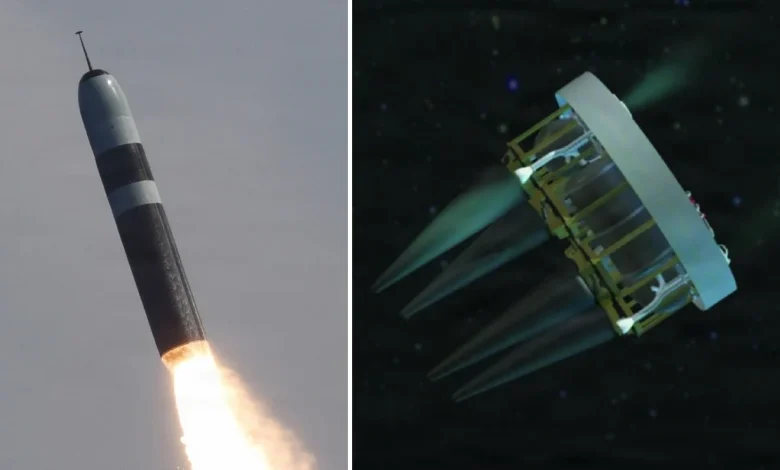
The U.S. Navy’s new submarine-launched nuclear warhead, the W93, has moved into full-scale development, the first U.S. nuclear warhead and reentry body program started in nearly 40 years.
The Navy’s Strategic Systems Programs office said the W93 and its Mk7 reentry body, the cone-shaped shell that carries the warhead back through the atmosphere to its target, passed Milestone B this year and have entered engineering and manufacturing development. In this phase, engineers finish the production design and prove the weapon can be built in the numbers the Navy needs. The office did not say when the milestone was reached or give a date for first production.
“W93/Mk7 will provide flexibility and adaptability to meet future Warfighter needs and ensure an uninterrupted at sea deterrent for the sea-based leg of the nuclear triad,” said Vice Adm. Douglas Williams, director of Strategic Systems Programs. “We were able to accelerate our entry into this next phase because of the dedicated partnership between PAE SSP, National Nuclear Security Administration, and our industry base. This is what working at hyper-speed looks like.”
The Navy runs the program with the National Nuclear Security Administration, the Department of Energy agency that designs and builds U.S. nuclear warheads, and its national laboratories. Los Alamos National Laboratory in New Mexico is designing the warhead.
“Credible deterrence demands that we move with urgency, and the progress we’re making on W93/Mk7 demonstrates exactly that,” said Brandon Williams, administrator of the National Nuclear Security Administration.
The W93 will arm the Trident II D5 ballistic missiles carried by U.S. Navy ballistic missile submarines, the part of the U.S. nuclear force that stays hidden at sea. Those missiles now carry two warheads: the W76, in service since 1978, and the W88, which entered the stockpile in 1988. The W76 rides in the Mk4 reentry body and the W88 in the Mk5.
Los Alamos said the W93 design uses nuclear components that were tested before the United States stopped explosive nuclear testing, updated with modern materials. The lab said the warhead is expected to go aboard Ohio-class submarines, likely starting in the mid-2030s, and later move to the new Columbia-class submarines as they replace the Ohio class.
The program completed its feasibility and design options phase in March 2025, according to Los Alamos, producing draft military requirements and a description of the conditions the weapon must survive from storage to detonation.
Britain is tied to the program through the Mk7. The United Kingdom will use the same reentry body for its own new warhead, the A21, known as Astraea. The British Ministry of Defence says Astraea is a sovereign design developed in parallel with the W93 and will arm the Royal Navy’s future Dreadnought-class submarines.
Strategic Systems Programs also maintains the Trident missile system on the Ohio-class boats and is integrating a life-extended version of the D5 on the Columbia class. The office is developing a follow-on missile, the D5LE2, as well as a nuclear-armed sea-launched cruise missile known as SLCM-N and the non-nuclear Conventional Prompt Strike hypersonic weapon.
Source: Defence Blog