Delivery of First British Type 31 Frigate Delayed by Two Years Until 2028
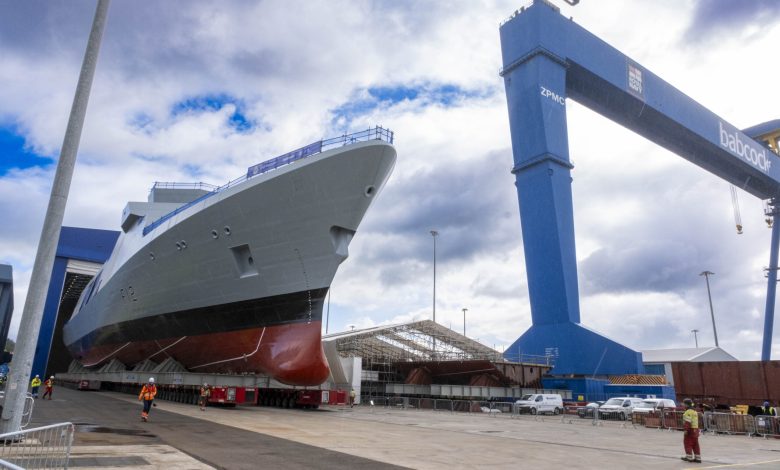
The first Type 31 frigate, HMS Venturer, is scheduled to be handed over to the UK Royal Navy in 2028.
Navy Lookout reported this.
The ship will be handed over to the Navy two years later than originally planned at the time of its launch.
Sir Nick Hine, Babcock’s Chief Executive Marine, said the company is working to reduce the schedule delay across the entire program to build five frigates.
He estimated that the delay could reach approximately two years. At the same time, the company hopes to minimize the impact of the first ship’s construction delay on subsequent deliveries across the program.
Hine cited the impact of the COVID-19 pandemic, the United Kingdom’s withdrawal from the European Union and Russia’s full-scale invasion of Ukraine among the main causes of the delays. These events drove up the cost of energy resources, labor, and components, and complicated supply chains.
Additional problems arose during the construction of the first two ships — HMS Venturer and HMS Active. Design changes, disruptions to the construction sequence, and the need to redo some work resulted in significant additional costs for the company.
In May 2026, Babcock announced a £140 million write-off to cover the costs of rectifying defects.
According to Navy Lookout, Babcock’s total losses under the Type 31 frigate construction contract have exceeded £300 million. Meanwhile, the company’s management notes that accelerating construction under the program’s current funding arrangements will be difficult without additional investment.
History of Program Delays
The United Kingdom originally planned to commission the first Type 31 frigate back in 2023. However, the schedule was revised in 2020: the ship was due to be launched in 2023, handed over to the Royal Navy in 2025 and commissioned in 2027.
During the construction of HMS Venturer, it was decided to keep the ship in the assembly hall for longer to install as much equipment as possible before launch. The vessel was moved out of the assembly hall on May 27, 2025, and launched on June 14 that year – approximately 15 months later than the schedule approved in 2020.
In October 2026, the UK Ministry of Defence told Parliament that HMS Venturer was expected to be handed over to the Navy by the end of the decade, without specifying an exact date. Meanwhile, shipbuilder Babcock is now targeting 2028, a delay of about two years from the previous schedule.
While the delay to the Type 31 program is estimated at approximately two years, the British Type 26 frigate construction program has also encountered serious difficulties.
Construction of the lead ship in the class, HMS Glasgow, began on July 20, 2017. It was originally scheduled to be handed over to the Navy in the mid-2020s, but the ship is now expected to achieve initial operational readiness only in October 2028.
After its launch in late 2022, HMS Glasgow was moved to a dry dock at BAE Systems’ Scotstoun facility, where fitting-out work is still underway. As of November 2026, the frigate has not yet been handed over to the Royal Navy.
Specifications of the Type 31 Frigate
- Displacement: 5,700 tonnes.
- Length: 138.7 m.
- Beam: 19.8 m.
- Maximum speed: 28 knots (approximately 52 km/h).
- Range: 7,500 nautical miles (according to Defence Equipment & Support).
- Crew: approximately 105 personnel, with additional accommodation for 40 people.
- Propulsion system: four MTU 20V 8000 M71 diesel engines manufactured by Rolls-Royce, each producing more than 8,000 kW.
- Power plant: four MTU 16V 2000 M41B diesel generators, each producing more than 900 kW.
Armament
- Universal artillery unit: 1 × 57 mm Bofors Mk 3 gun.
- Secondary artillery armament: 2 × 40 mm Bofors Mk 4 automatic guns.
- Surface-to-air missile system: Sea Ceptor system with CAMM missiles for air defence in 32 Mk 42 cells, as planned. The first three ships will temporarily use 12 GWS.35 cells.
Source: Militaryni