UK Launches Titania Military Satellite to Test Laser Communications
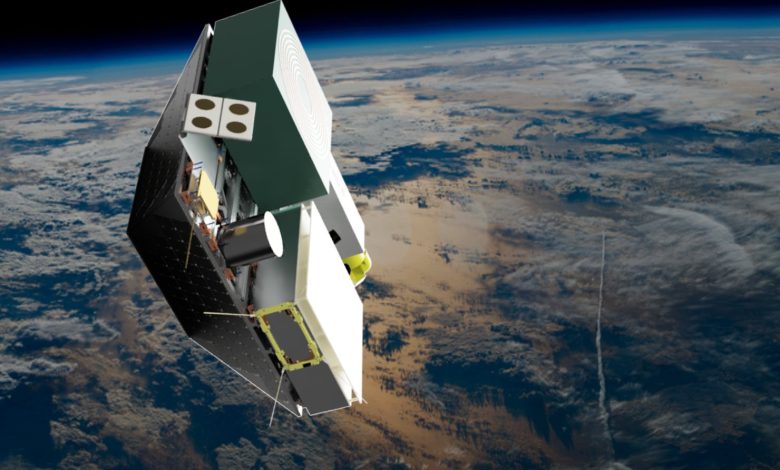
The United Kingdom has launched the Titania satellite to test secure laser communications between space and ground stations. Meanwhile, the country has started testing a new network of ground-based sensors designed to detect threats to British satellites.
The UK Ministry of Defence announced the developments.
The launch, which took place last month, will help the armed forces coordinate activities on Earth and in space, improving their ability to monitor military activity on the ground, the ministry shared.
Titania is the second satellite in the UK’s military constellation being developed under the ISTARI program, following the successful launch of Tyche in 2024.

Like Tyche, Titania weighs about 100 kilograms and is roughly the size of a washing machine. It orbits Earth every 90 minutes at 27,000 kilometers per hour.
At the same time, the Ministry of Defence is launching Project Inaros, which will test an advanced space surveillance network using sensors at three sites worldwide.
The project will test three ground-based neuromorphic sensors developed by British-Australian company Optera in cooperation with the National Security Strategic Investment Fund. They will track objects in space from sites in the United Kingdom, Australia, and British facilities on the island of Cyprus.
The technology mimics biological processes by detecting changes in light levels. In the future, it could form the basis of an early warning system for unusual or potentially threatening activity near British satellites.
The information collected by Inaros will help units of the UK Space Command, including the 1st Space Operations Squadron, the 2nd Space Warning Squadron and the newly established 3rd Space Effects Squadron, protect British satellites.
ISTARI Program
ISTARI is a UK Ministry of Defence program to develop a sovereign satellite constellation for intelligence and surveillance. It also includes deploying ground infrastructure to control the satellites and receive, process, and distribute data.
The program envisages five satellites across four projects: Tyche, Titania, Juno, and two Oberon spacecraft. Ministry of Defence plans expect the launch of Juno and Oberon in 2028.
Tyche is an electro-optical satellite built by SSTL that was launched in August 2024. It provides daytime imaging and video of the Earth’s surface to monitor military activity.
Titania is an experimental satellite designed to test high-speed laser communications between orbit and Earth. Its task is to demonstrate the transmission of large volumes of intelligence data through a narrow laser beam to the Puck ground-based optical station, with a low probability of the signal being detected or intercepted.
Juno is another electro-optical satellite SSTL is developing under a £40 million contract. It will carry upgraded optical sensors for daytime imaging of the Earth’s surface and expand intelligence capabilities alongside Tyche.
Oberon is a system of two Airbus radar satellites, each weighing about 400 kilograms. Equipped with synthetic aperture radar (SAR), the spacecraft will image the Earth’s surface day and night, including through cloud cover and in adverse weather conditions.
Source: Militaryni