U.S. Air Force orders 15 more KC-46A tankers in $2.8 billion deal
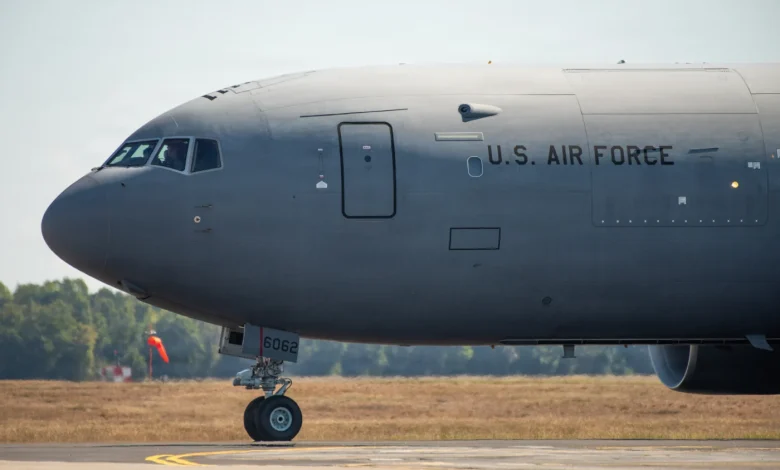
The U.S. Air Force has ordered 15 more KC-46A Pegasus tankers from Boeing in a $2.82 billion contract modification. By previously reported counts, the order fills the last slots available under the 2011 tanker contract.
The U.S. Department of War announced the award Nov. 24. It covers “15 KC-46A Lot 13 production aircraft” plus “G081, subscriptions, and licenses,” according to the contract notice. Work will be done in Seattle and is “expected to be completed by June 30, 2030.”
The full $2,819,046,560 comes from fiscal 2027 aircraft procurement funds, and all of it is being obligated at the time of award. The deal modifies the original KC-46 production contract, FA8625-11-C-6600. The notice says that “for administrative purposes” the modification has been placed under a new number, FA8609-27-C-B002. The Air Force Life Cycle Management Center at Wright-Patterson Air Force Base, Ohio, is the contracting activity.
Boeing won the Lot 12 order for 15 tankers on Nov. 25, 2025, for $2,469,937,348, with the same G081, subscriptions and licenses line items and a June 30, 2029, completion date. Lot 13 costs about $349 million more for the same number of aircraft. That works out to roughly $188 million per tanker, against about $165 million in Lot 12, an increase of around 14%. Both totals include items other than the airframes, so neither figure is a flyaway cost. Lot 11, awarded in November 2024, was worth about $2.38 billion.
Lot 13 should bring the Air Force’s total order to the most the original contract allows. Boeing had 143 aircraft on order for the service after the 10th lot, according to earlier reporting. Lots 11, 12 and 13 each added 15 jets, which by The Defence Blog’s count makes 188. The Air Force first planned to buy 179 KC-46s and later raised that to 188, which a service spokesperson described as the maximum available under the current contract. The new notice doesn’t give a running total.
Boeing successfully protested the Air Force’s first award, the service ran the contest again, and Boeing won in 2011. Boeing’s annual filings describe the deal as a fixed-price incentive fee development contract valued at $4.9 billion, with production options that would deliver 179 aircraft if all were exercised. In 2016 the Air Force authorized the first two low-rate production lots, of 7 and 12 aircraft, valued together at $2.8 billion. Deliveries began in 2019.
Under a fixed-price contract, Boeing pays for cost overruns, and the KC-46 has cost it billions. On Jan. 27 the company took a $565 million charge on the tanker. Boeing blamed higher supply chain costs and extra production support at its Everett, Washington, plant, most of it linked to the 767 airliner the KC-46 is built from.
CEO Kelly Ortberg called the program a “bad contract for the last decade” on the company’s earnings call. Boeing’s losses on the tanker now exceed $7 billion, and the total cost overrun on the fixed-price contract has been put at $9.55 billion.
The tanker’s airframe is the 767-2C. It pairs the fuselage of the 767-200ER with the wing, landing gear, cargo floor and cargo door of the 767-300F freighter. The jet can refuel with its centerline boom, a centerline drogue, or wing-mounted pods. That lets it serve U.S. Air Force receivers and probe-equipped U.S. Navy and U.S. Marine Corps aircraft on the same sortie.
The boom is where most of the trouble has been. On the KC-135, the boom operator lies prone at the rear of the aircraft and looks out a window. On the KC-46, the operator sits behind the cockpit and flies the boom using camera images on screens. The operator watches the receiver close in, steers the boom toward the receptacle, then extends the nozzle to make contact. In some lighting, the original Remote Vision System doesn’t give operators a clear view of the receptacle. If the boom scrapes the receiving aircraft, it can damage it. The fleet has also lost two booms in flight within a year.
The fix, Remote Vision System 2.0, adds better cameras, color video and improved depth perception. Boeing is developing it with Collins Aerospace as the main subcontractor. It was originally due in 2023. The date then slipped to October 2025, then to 2026, then to summer 2027. In June, the Air Force said RVS 2.0 would “begin fielding in early 2028,” with installation on new-production KC-46s starting in the second quarter of fiscal 2028.
Existing jets will get the upgrade during depot-level maintenance, and that plan cuts the retrofit schedule from 13 years to seven. Boeing has also redesigned the boom’s telescoping actuator. The original made the boom too stiff for aircraft such as the A-10 Thunderbolt II, which can’t produce enough thrust to push it into place. Until both fixes are in, the Pentagon’s test office can’t close out initial operational testing of the tanker.
Fleet readiness is still a problem. The KC-46 had a 62% mission capable rate in 2024, the last year the Air Force released the figure. William Bailey, the acting assistant secretary of the Air Force for acquisition, technology and logistics, told lawmakers in May that the fleet “still faces readiness challenges.”
To address it, the Air Force and Boeing agreed this summer on what the service called a “multipronged” plan. It includes better contractor logistics support and a five-year performance-based logistics agreement covering the aerial refueling subsystem and other key components. The service named that subsystem’s reliability and parts availability as the biggest drags on availability. Bailey said the effort should raise availability by about 6% in the near term and by more than 20% by 2030. In June, the service also spread $471 million in parts exchange and repair contracts across 28 companies.
Boeing said in late May that the U.S. Air Force was flying 107 KC-46As. That was when it delivered the first of six tankers on contract for the Israeli Air Force. Israel’s second aircraft landed at Nevatim Airbase in August. Japan’s Air Self-Defense Force has six.
Exports go through a separate Foreign Military Sales contract, and the Air Force raised its ceiling to $19.1 billion this year. Qatar has been cleared to buy up to four.
Lot 13 also matters for the next buy. In July 2025 the Air Force dropped plans for a “bridge tanker” competition. It chose instead to buy up to 75 more KC-46s, which would take its planned fleet to 263. The service said at the time that the extension “will maintain uninterrupted tanker recapitalization after final delivery under the current contract.” Boeing was notified on April 1 of an upcoming contract for the 75 aircraft.
That contract hasn’t been signed. Gen. John D. Lamontagne, the Air Force vice chief of staff, told lawmakers in March that the service is “not going to get a new contract for another 75 KC-46s until we work through some of those deficiencies.” He said the deal likely wouldn’t come for another “couple of years.”
Source: Defence Blog