

How fast is the universe expanding?
That the universe is expanding has been known for almost a hundred years now, but how fast? The exact rate of that expansion remains hotly debated, even challenging the standard model of cosmology.
A research team at the Technical University of Munich (TUM), the Ludwig Maximilians University (LMU) and the Max Planck Institutes, MPA and MPE, has now imaged and modeled an exceptionally rare supernova that could provide a new, independent way to measure how fast the universe is expanding. The studies are published on the arXiv preprint server.
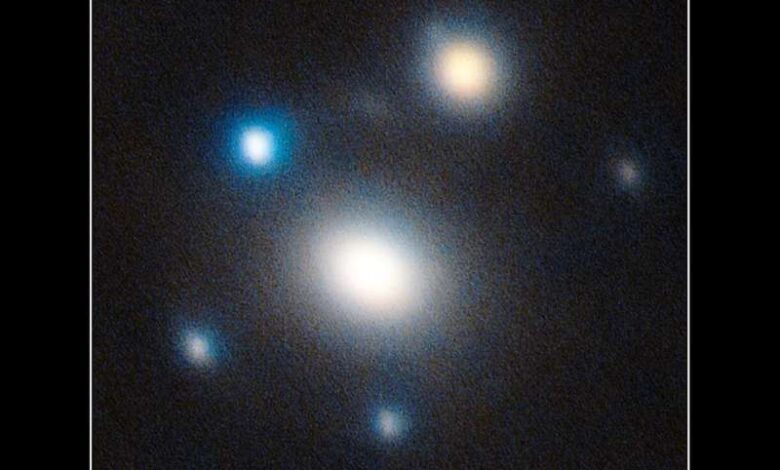
The supernova is a rare superluminous stellar explosion, 10 billion light-years away, and far brighter than typical supernovae. It is also special in another way: the single supernova appears five times in the night sky, like cosmic fireworks, due to a phenomenon known as gravitational lensing.
Two foreground galaxies bend the supernova’s light as it travels toward Earth, forcing it to take different paths. Because these paths have slightly different lengths, the light arrives at different times. By measuring the time delays between the multiple copies of the supernova, researchers can determine the universe’s present-day expansion rate, known as the Hubble constant.
Sherry Suyu, Associate Professor of Observational Cosmology at TUM and Fellow at the Max Planck Institute for Astrophysics, explains, “We nicknamed this supernova SN Winny, inspired by its official designation SN 2025wny. It is an extremely rare event that could play a key role in improving our understanding of the cosmos. The chance of finding a superluminous supernova perfectly aligned with a suitable gravitational lens is lower than one in a million. We spent six years searching for such an event by compiling a list of promising gravitational lenses, and in August 2025, SN Winny matched exactly with one of them.”
High-resolution color image of unique supernova
Because gravitationally lensed supernovae are so rare, only a handful of such measurements have been attempted to date. Their accuracy depends strongly on how well one can determine the masses of the galaxies acting as a lens, because these masses control how strongly the supernova’s light is bent.
To measure those masses, the team members from MPE and LMU obtained images with the Large Binocular Telescope in Arizona, U.S., using its two 8.4-meter diameter mirrors and an adaptive optics system that corrects for atmospheric blurring. The result is the first high-resolution color image of this system published to date.
The observations reveal the two foreground lens galaxies in the center and five bluish copies of the supernova—reminiscent of a firework exploding. This is quite unusual, since galaxy-scale lens systems normally produce only two or four copies. Using the positions of all five copies, Allan Schweinfurth (TUM) and Leon Ecker (LMU), junior researchers in the team, built the first model of the lens mass distribution.
“Until now, most lensed supernovae were magnified by massive galaxy clusters, whose mass distributions are complex and hard to model,” says Schweinfurth.
“SN Winny, however, is lensed by just two individual galaxies. We find overall smooth and regular light and mass distributions for these galaxies, suggesting that they have not yet collided in the past despite their close apparent proximity. The overall simplicity of the system offers an exciting opportunity to measure the universe’s expansion rate with high accuracy.”