Using the James Webb Space Telescope (JWST), an international team of astronomers has discovered a new Type II supernova.
The newly detected supernova, named SN Eos, exploded when the universe was only 1 billion years old. The finding was reported January 7 on the arXiv pre-print server.
What do supernovae tell us about stellar evolution?
Supernovae (SNe) are powerful and luminous stellar explosions. They are important for the scientific community as they offer essential clues into the evolution of stars and galaxies. In general, SNe are divided into two groups based on their atomic spectra: Type I (no hydrogen in their spectra) and Type II (showcasing hydrogen spectral lines).
Type II SNe are the result of rapid collapse and violent explosion of massive stars (with masses above 8.0 solar masses). Type II core-collapse supernovae (CC SNe), which can be brighter than the total emission of their host galaxies, allow astronomers to probe the final stages of stellar evolution, and studies of early-universe Type II CC SNe could be crucial to constrain early stellar evolution models.
Goddess of the dawn found
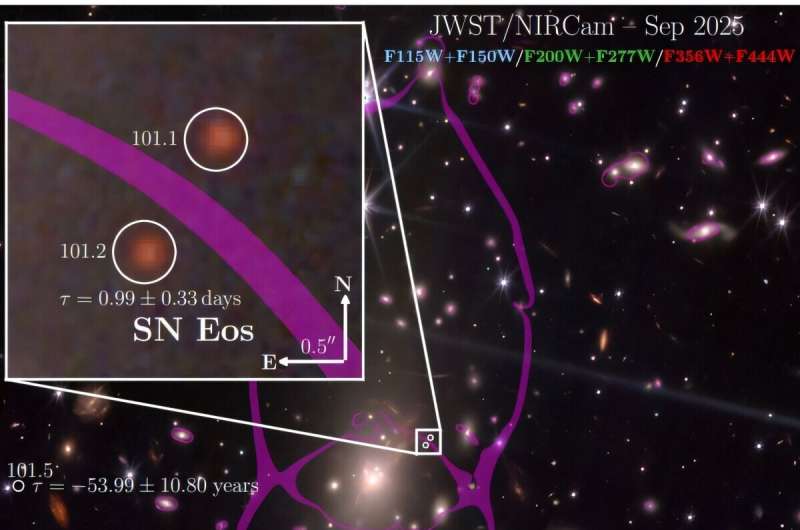
Now, a group of astronomers led by David A. Coulter of the Johns Hopkins University in Baltimore, Maryland, has apparently detected such an early-universe Type II SN. They report that using the gravitational lensing method, which leads to the appearance of multiple magnified images of the background object, they identified a supernova which would be too faint to detect by employing other techniques.
“Here we present ‘SN Eos,’ a multiply-imaged, strongly lensed transient discovered as a pair of images observed on September 1, 2025 by VENUS in JWST/NIRCam imaging of the MACS 1931.8-2635 galaxy cluster field,” the researchers write in the paper.
The supernova was named Eos after the Titan goddess of the dawn in Greek mythology. It has a spectroscopic redshift of 5.133 and is embedded in a very faint Lyman-alpha emitting galaxy. Therefore, it makes it the farthest spectroscopically confirmed supernova ever discovered.
Exploding early on an astronomical timescale
The collected data indicate that SN Eos exploded when the universe was only about 1 billion years old, shortly after it reionized and became transparent to ultraviolet radiation. The measurements conducted by Coulter’s team suggest that SN Eos exploded in an environment with a metal concentration below 10% that of the solar abundance.
The study found that in the rest-frame, SN Eos had variable, bright, and rising far-ultraviolet (FUV) emission. The analysis of the ultraviolet emission indicates that SN Eos is a Type IIP supernova at the end of its plateau phase. In general, Type II-Plateau supernovae (SNe IIP) remain bright (on a plateau) for an extended period of time after maximum.
The authors of the paper conclude that SN Eos is an example of a strongly lensed, multiply-imaged, extremely metal-poor SN IIP. They note that the discovery of this supernova underscores JWST’s core mission objectives of understanding the lives and deaths of the first stars, the origins of the elements, and the assembly and evolution of the youngest galaxies.