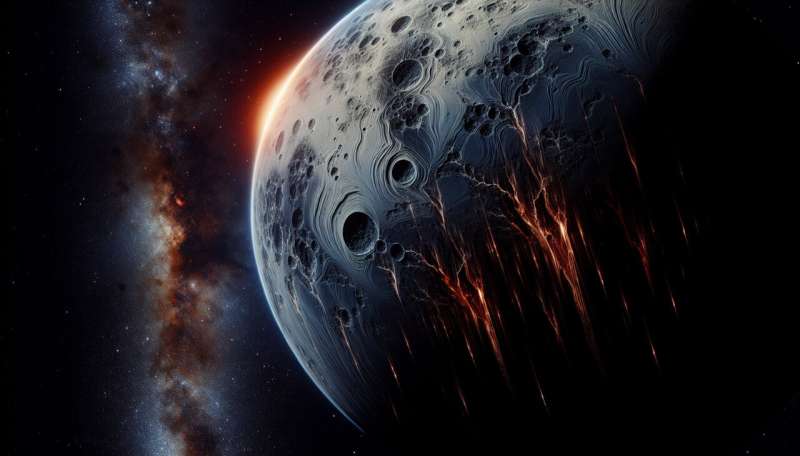
While most planets that we are familiar with stick relatively close to their host star in a predictable orbit, some planets seem to have been knocked out of their orbits, floating through space free of any particular gravitational attachments. Astronomers refer to these lonely planets as “free-floating” or “rogue” planets.
Recently, a new rogue planet was identified, and, unlike previously identified rogue planets, astronomers were able to calculate both its mass and distance from Earth. A new study, published in Science, describes how a few lucky observations from both ground-based and space-based telescopes made these calculations possible.
The problem with rogue planets
The methods used to find other extrasolar planets rely heavily on their host stars. For example, many planets have been found through the transit method, in which the planet is found through the periodic dimming of its host star’s light as it passes in front of the star. Another method detects a slight wobbling of the host star due to the gravity of an orbiting planet. Of course, without a host star, these methods cannot be used to find a planet. On top of that, planets are not emitting their own light like a star, making them effectively invisible.
The only way astronomers have been able to detect rogue planets is through microlensing events caused by the slight gravitational effect of an object on background light. This occurs when the light from a distant star suddenly appears magnified to an observer (telescopes on Earth), as if a lens were placed in front of it. The magnification of light lets astronomers know that something has passed in front of the distant star.
Theoretically, microlensing can allow for the calculation of the mass of the object passing in front of the star by analyzing how much the light was bent and thus magnified. But, not knowing the object’s distance results in what astronomers call “mass-distance degeneracy,” meaning they can’t be certain of the mass because the same microlensing light curve can result from different combinations of mass and distance. So, without knowing one of these properties, they cannot be certain of the other, resulting in only estimates.
Serendipitous geometry
This particular rogue planet’s microlensing effect was observed by multiple telescopes on Earth, as well as the space-based telescope, Gaia. After detection, it was named by two different groups, resulting in the two names: KMT-2024-BLG-0792 and OGLE-2024-BLG-0516.
And thanks to the timing of the event, Gaia was in a perfect position to allow for measurements enabling the calculation of the planet’s distance. The observations from two different points and a slight difference in the timing of the light signal allowed the team to calculate the microlensing parallax and determine the distance.
“Serendipitously, the KMT-2024-BLG-0792/OGLE-2024-BLG-0516 microlensing event was located nearly perpendicular to the direction of Gaia’s precession axis. This rare geometry caused the event to be observed by Gaia six times over a 16-hour period, beginning close to peak magnification,” the study authors write.
From their data, they determined that the planet had a mass of around 22% that of Jupiter, or just under the mass of Saturn. They calculated the planet to be around 3,000 parsecs (or just under 10,000 light years) away. Spectral analysis also found that the star it passed in front of was a red giant.
The ‘Einstein desert’ and rogue planet origins
Previously identified rogue planets have mostly been thought to be below the mass of Jupiter, which researchers say indicates that they were planets that were formed in a protoplanetary disk and were later thrown out. Larger objects have also been identified to float freely through space, but these are most likely brown dwarfs—a kind of failed star that is too massive to be a planet but not massive enough to become a star.
Previous microlensing events showed a gap in their radial distribution referred to as the “Einstein desert,” which is known to separate planets from brown dwarfs. The team says the gap makes sense because more massive planets are less likely to be ejected due to dynamical processes.
The study authors write, “Although previous free-floating planet (FFP) events did not have directly measured masses, statistical estimates indicate that they are predominantly sub-Neptune mass objects, either gravitationally unbound or on very wide orbits.
“Such objects can be produced by strong gravitational interactions within their birth planetary systems. We conclude that violent dynamical processes shape the demographics of planetary-mass objects, both those that remain bound to their host stars and those that are expelled to become free floating.”
-
-
-
-
-