Australia Orders Six Ghost Bat ‘Loyal Wingman’ Drones for $930M
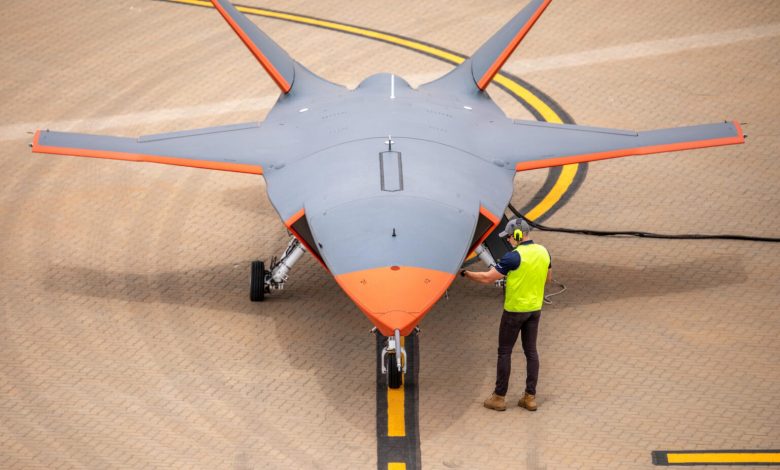

Australia has contracted Boeing Defence Australia to supply an additional six MQ-28 Ghost Bat Collaborative Combat Aircraft.
The 1.4-billion Australian dollar ($930-million) agreement advances the Australian-designed and -built platform from a technology demonstrator to operational capability for the Royal Australian Air Force.
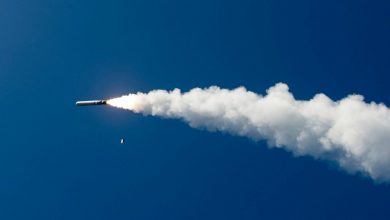
The contract follows the Ghost Bat’s first live-fire weapon test, during which the drone launched an AIM-120 AMRAAM at an aerial target.

Under the deal, six Block 2 Ghost Bats will be delivered and an enhanced Block 3 prototype will be developed over the next three years to support the goal of achieving operational capability by 2028.
The agreement also incorporates several design updates, including the addition of an internal weapons bay.
Australia has already ordered eight Block 1 and three Block 2 Ghost Bats.
Broader Drone Investment
The program forms part of a broader 10-billion Australian dollar ($6-billion) investment in drones over the next decade, including at least 4.3 billion Australian dollars ($2.82 billion) dedicated to uncrewed aerial systems.
The Ghost Bat effort supports more than 440 high-skilled jobs nationwide.
“With Ghost Bat, the future of collaborative air combat is right here, right now. Today’s announcement highlights that Australia is leading the world in the development of collaborative combat aircraft,” Australian Minister for Defence Industry Pat Conroy said.
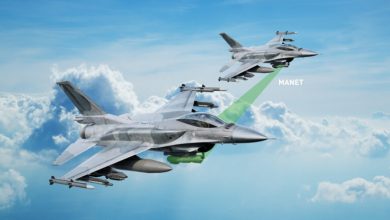
“The Ghost Bat transforms a single fighter jet into a formidable team — capable not only of surveillance but also of engaging adversaries.
This delivers a vital layer of protection for our aviators who remain our most valuable asset.”
Loyal Wingman
Designed as a collaborative combat partner, the Ghost Bat provides advanced sensing and targeting capabilities that increase the survivability and operational reach of fighter fleets.
The aircraft features a reconfigurable nose section that can be swapped out to carry mission-specific payloads, including AESA radar, electro-optical sensors, electronic attack suites, signals intelligence packages, and, in the future, compact internal weapons bays.
At 38 feet (11.7 meters) long, the MQ-28 delivers a range exceeding 2,000 nautical miles (2,302 miles/3,704 kilometers) and costs about one-tenth of a typical crewed aircraft.