Austria’s Rocket-Armed Helicopter Drone Debuts
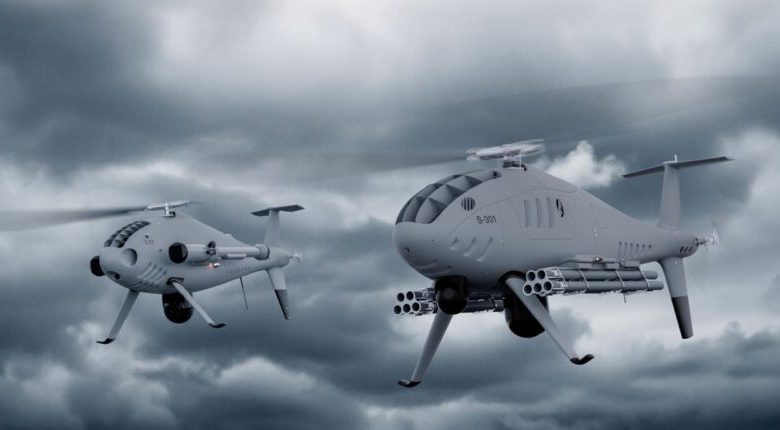
Camcopter S-301 is a next-gen helicopter drone, weighing 485 kilograms, carrying up to 110 kilograms of payload, capable of over 10 hours of flight endurance, and equipped with two rocket pods.
Austria is bringing more muscle to its homegrown unmanned capability with Schiebel’s new vertical take-off and landing (VTOL) helicopter drone, designed for both land and naval missions.
The Camcopter S-301 is a 485-kilogram (1,070-pound) unmanned aerial system (UAS) powered by a military-standard engine and can run on the same fuel already used by NATO aircraft.
It can carry up to 110 kilograms (240 pounds) of payload, stay airborne for up to 10 hours, and operate at altitudes of up to 5,500 meters (18,000 feet).

The drone’s rotor spans about 4.8 meters (15.7 feet), while the airframe measures roughly 4.7 meters (15.4 feet) long and stands about 1.8 meters (5.9 feet) tall.
Schiebel said the platform can be launched from ships or vehicles without specialized equipment, enabling operations in remote or contested areas with minimal support.
Its modular design also lets operators switch between intelligence, surveillance, and reconnaissance (ISR) and strike roles quickly with minimal downtime.
Cutting-Edge Firepower
Revealed at UMEX 2026, the Camcopter S-301 is the latest evolution of Schiebel’s S-300 rotary-wing UAS, now weaponized for military missions.
The drone was shown carrying two Thales FZ602 rocket pods mounted on reinforced wing stubs, each loaded with seven Thales FZ275 laser-guided munitions.

Beyond the strike role, it can be outfitted with a range of sensors, including day-night imaging, wide-area and maritime radars, and electronic warfare payloads.
Schiebel said the drone supports full autonomy, including automatic takeoff and landing, preplanned routes, mid-mission task changes, and automatic return to base in emergencies.
In addition, the platform relies on multiple navigation systems and includes built-in safeguards designed to recover from engine issues and land safely if conditions deteriorate.