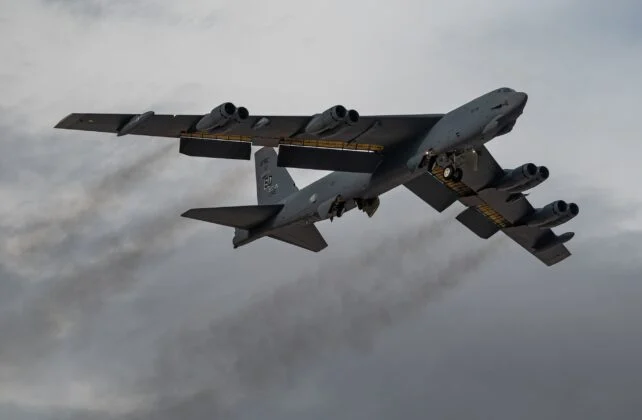
Boeing has been awarded a $2.04 billion task order to continue development work on the B-52 Commercial Engine Replacement Program, a major step in the long-running effort to modernize the U.S. Air Force’s B-52H bomber fleet.
According to the award notice, the task order covers post–Critical Design Review development under the B-52 Commercial Engine Replacement Program, or CERP. The work will focus on completing system integration activities following the Critical Design Review and on modifying and testing two B-52 aircraft with new engines and associated subsystems.
The contract was awarded to Boeing Defense Systems of Oklahoma City, Oklahoma. Work will be performed in Oklahoma City; San Antonio, Texas; Seattle, Washington; and Indianapolis, Indiana. The effort is expected to be completed by May 31, 2033.
The task order will be incrementally funded, beginning with Fiscal 2026 research, development, test, and evaluation funds. At the time of award, $35.8 million was obligated. The contracting activity is Tinker Air Force Base, Oklahoma.
The B-52H CERP is being executed as a Middle Tier of Acquisition rapid prototyping program and is planned to transition into a Major Capability Acquisition program. The Air Force is currently using a Middle Tier–developed Virtual System Prototype digital design tool to support early performance analysis, production process planning, system support analysis, and initial training activities.
CERP represents the final phase of a broader, multi-program modernization effort for the B-52H fleet. The upgrade replaces the bomber’s legacy TF33 engines with Rolls-Royce F130 commercial derivative engines. According to program documentation, the new engines are intended to improve system reliability and reduce long-term sustainment costs.
The engine replacement is also expected to improve fuel efficiency, increase onboard electrical power generation capacity, and introduce modern digital engine controls and cockpit displays. These upgrades are designed to support additional avionics, sensors, and weapons integration planned for the aircraft over the coming decades.
The B-52H Stratofortress remains a central element of U.S. long-range strike capability. Theater commanders use B-52H units to conduct long-range, all-weather conventional and nuclear strike operations against ground and maritime targets. The aircraft supports a wide range of missions, including strategic attack, time-sensitive targeting, air interdiction, close air support, suppression and destruction of enemy air defenses, maritime mining, and nuclear deterrence.
The Air Force plans for the bomber to remain in service into the 2050s, making propulsion modernization a key enabler of extended service life and operational flexibility.
The post-Critical Design Review phase covered by this task order moves the program from design validation toward hands-on aircraft modification and testing. Modifying two aircraft will allow engineers to validate integration, performance, and supportability before the program transitions to broader fleet implementation.
-
-

-
-
-