
China tests new modular air defense system
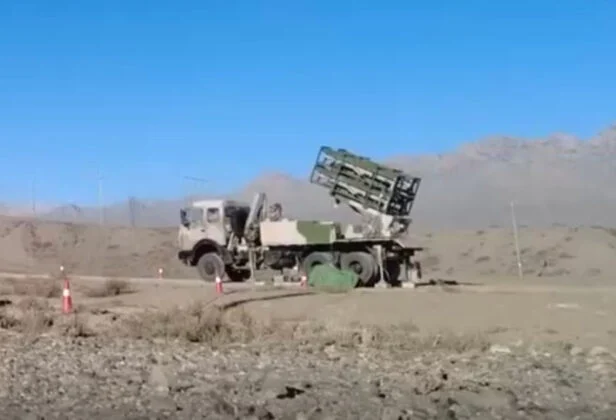
Chinese state broadcaster CCTV-7 has released footage of a previously unseen air defense system during a recent live-fire training exercise in the Gobi Desert.
The system, likely a short-range air defense platform, was shown launching surface-to-air missiles in what appeared to be high-precision strike tests. The new complex features a modular launcher mounted on a wheeled military truck chassis, suggesting rapid deployment capabilities across varied terrain.
According to open-source visual analysis of the broadcast, the interceptor missile used in the launch may be derived from an air-to-air missile type, adapted for ground-based air defense—an approach similar to Norway’s use of AIM-120 AMRAAMs in the NASAMS system.
CCTV-7 did not name the missile or platform, and the Chinese Ministry of National Defense has yet to formally announce the system or its intended deployment timeline. However, the presence of modular components and mobile integration implies a system tailored for tactical-level protection of military columns or key infrastructure against aerial threats.
Military analysts suggest the system could be part of a broader upgrade of the People’s Liberation Army Ground Force’s short-range interception capabilities amid rising concerns over drone, cruise missile, and helicopter threats in border regions and key infrastructure corridors.

There has been growing attention on Chinese developments in air defense systems in recent years. China already fields several layers of SAM systems, ranging from the HQ-9 long-range series to close-range MANPADS and gun-based solutions.
While not officially confirmed, the new system’s architecture and use of what appears to be repurposed air-to-air missiles indicate an emphasis on cost-efficiency and interoperability within China’s existing missile ecosystem.