Experts say Türkiye-Qatar deal will strengthen Gulf security
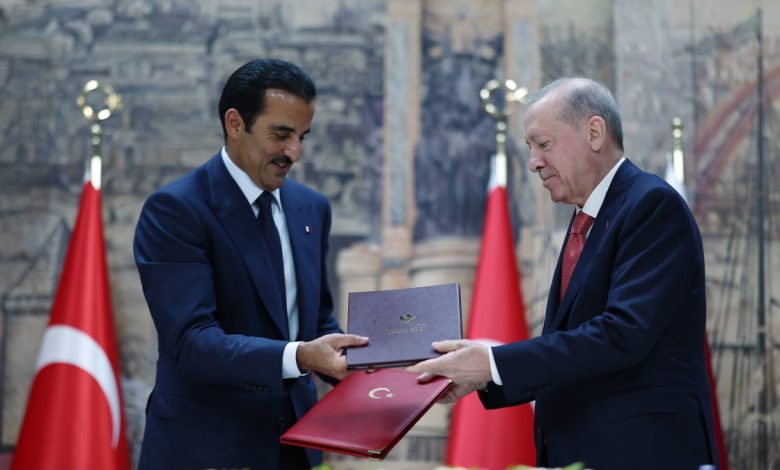
Türkiye and Qatar cemented their longstanding cooperation with a joint defense agreement on Nov. 13. Experts point out that the deal will contribute not only to Qatar’s security but also to the security of the entire Gulf region.
Speaking to Anadolu Agency (AA), Middle East and Gulf experts assessed the agreement signed during the 12th Meeting of the High Strategic Committee of the two countries held in Istanbul. They also discussed the possibility of renewed hostilities between the United States and Iran, in which Qatar has been conducting mediation efforts, as well as Houthi attacks against Saudi Arabia.
Mohammed Saleh Al-Misfer, a Qatari professor of political science and Gulf studies expert, said the joint defense agreement signed between Türkiye and Qatar would strengthen Qatar’s security position and contribute to the security of the Gulf Cooperation Council (GCC) countries. Noting that relations between Türkiye and Qatar date back to the Ottoman period, Al-Misfer said these ties had developed over time across the political, economic and security fields. Assessing the agreement’s potential contribution to regional security cooperation, referred to as the “Mecca Alliance,” Al-Misfer said, “Cooperation between the two sides strengthens the security of GCC countries and Qatar’s security position. It also further consolidates the friendship and strategic partnership between Ankara and Doha.”
Regarding the possibility of renewed hostilities between the United States and Iran, between which Qatar has been conducting mediation efforts, Al-Misfer said the risk of another conflict remained and that any potential war would particularly affect the security of Gulf countries. “War could break out at any moment. It is impossible to predict when it will begin. However, current circumstances are conducive to a new war, with the United States and Israel on one side and Iran on the other,” he said. Noting that the consequences of a potential conflict could spread across the wider Middle East, Al-Misfer added that Türkiye’s close relations with Arab countries could further strengthen its position in the region.
Assessing the regional implications of Houthi attacks against Saudi Arabia, Al-Misfer said the Houthis did not represent Yemen and that the conflict in the country was fundamentally rooted in the struggle between the internationally recognized government and the Houthis. Al-Misfer stated that Saudi Arabia possessed sufficient deterrent capabilities to respond to attacks by the Houthis, whom he described as being linked to Iran, and that cooperation with its partners could further enhance these capabilities. Warning that a prolonged conflict could have economic, social and security consequences for Saudi Arabia, Al-Misfer said, “This situation could affect the entire Gulf region and the Middle East.” He added that the likelihood of foreign intervention could also increase if the conflict continued.
Betül Doğan Akkaş, a faculty member in the Department of International Relations at Ankara University’s Faculty of Political Sciences and a Gulf studies expert, commented on the joint defense cooperation agreement signed between Türkiye and Qatar: “Qatar already has an ongoing process of military rapprochement with Türkiye. No other Gulf country has reached this level of military cooperation with Türkiye.” Drawing attention to Türkiye’s military base in Qatar, existing military agreements between the two countries and the Badr Memorandum of Understanding, Akkaş said the defense agreement had brought Qatar and Türkiye significantly closer. However, she noted that Qatar’s potential participation in the Mecca Defense Alliance could take some time.
Akkaş said whether the Mecca Defense Alliance would expand was an important question for both its current members and countries outside the alliance. She added that regional countries might become more willing to join as the alliance’s institutional structure and the conditions under which it would operate became clearer.
Describing the Badr Memorandum of Understanding, signed between Qatar, Türkiye, Indonesia and Pakistan, as a framework for cooperation in the defense industry, Akkaş said joint production, cooperation in the field of ammunition and information sharing were its key components. Noting that joint production in the defense industry could also pave the way for closer political relations between countries, Akkaş said, “You can develop a closer sense of partnership with countries with which you produce things together.” Akkaş added that she regarded the defense agreement signed between Qatar and Türkiye as a step that would strengthen the security of the Gulf region. Akkaş said the possibility of renewed hostilities between the United States and Iran remained, adding that domestic political developments in the United States would play a decisive role in President Donald Trump’s decisions on the matter. Stating that Iran was attempting to increase its leverage at the negotiating table by demonstrating its military capabilities against Gulf countries, Akkaş said the crisis in the Strait of Hormuz also provided Tehran with bargaining power in negotiations. She noted that even if the attacks came to an end, Gulf countries’ security concerns could persist for several more years.
Akkaş said the Houthis’ influence in Yemeni politics and across the region had increased, explaining that the group derived its strength not only from Iranian support but also from its organizational structure in northern Yemen and its experience on the ground. She said she did not expect Saudi Arabia to achieve a military outcome on its own in the short term. Airstrikes had failed to neutralize the Houthis, she noted, while ground clashes posed serious risks to civilians. Akkaş said Saudi Arabia should seek a diplomatic settlement with the Houthis, as it had done in previous negotiations, adding that government forces in Yemen were not as well organized on the ground as the Houthis. “The Houthis constitute a minority of Yemeni society. However, under the current circumstances, it is impossible to achieve stability without engaging them in political dialogue,” she said.
Source: Daily Sabah