
Global arms sales hit fresh record as Türkiye adds new firm to top 100 list
Türkiye has a new company among the world’s top 100 weapons-producing companies, according to a report on Monday that showed global sales of arms and military services hit a new record last year, fed by wars and intensifying geopolitical tensions, but production issues hampered deliveries.
Revenues of the world’s 100 largest arms makers rose 5.9% to $679 billion, the Stockholm International Peace Research Institute, or SIPRI, said, the highest level recorded since the think tank began tracking data. Over the 2015-2024 period, the figure increased by 26%, the report stated.
The bulk of the increase was down to companies based in Europe and the United States, but there were increases around the world – except in Asia and Oceania, where problems in the Chinese arms industry led to a slight fall.
SIPRI said demand was fuelled primarily by the wars in Ukraine and Gaza, rising geopolitical frictions at global and regional levels, and steadily increasing military spending.
Many companies expanded production lines, built new facilities, founded subsidiaries, or acquired competitors to meet demand, the think tank said.
“Last year global arms revenues reached the highest level ever recorded by SIPRI as producers capitalized on high demand,” Lorenzo Scarazzato, researcher with the SIPRI Military Expenditure and Arms Production Program, said in a statement.
According to SIPRI, demand from Ukraine, as well as from countries militarily supporting it and which need to replenish stockpiles, helped drive demand.
Supply woes
The United States remained the dominant force in the market, with 39 of the top 100 firms. Thirty of those companies – including Lockheed Martin, Northrop Grumman and General Dynamics – posted increases in sales.
Their combined revenue was up 3.8% at $334 billion, nearly half of the global total. But SIPRI noted that “widespread delays and budget overruns continue to plague development and production” in major U.S.-led programs, including the F-35 fighter jet and the Columbia-class submarine.
For the first time, Elon Musk’s space company SpaceX entered the top 100, ranking 77th. Its defence revenue more than doubled year-over-year to $1.8 billion, SIPRI said.
Twenty-three of the 26 companies in Europe, excluding Russia, saw their arms revenue increase as the continent boosted spending. Their aggregate income rose by 13% to $151 billion, fueled by demand linked to the war in Ukraine and the perceived threat from Russia.
There were notably big gains for the Czech Republic’s Czechoslovak Group, whose revenue soared by 193% – the sharpest increase of all the top 100 – reaching $3.6 billion, thanks in part to a government-led project to source artillery shells for Ukraine.
Ukraine’s state-owned JSC Ukrainian Defense Industry increased its sales by nearly 41% to over $3 billion.
German manufacturers also posted sharp gains. Combined sales of Rheinmetall, ThyssenKrupp, Hensoldt and Diehl jumped 36% to $14.9 billion. Rheinmetall, Germany’s largest defense firm, recorded a 46.6% rise in sales to $8.24 billion, placing it 20th globally.
European firms are investing in new production capacity to meet greater demand, but SIPRI researcher Jade Guiberteau Ricard cautioned in a statement that “sourcing materials could pose a growing challenge,” with restructuring of supply chains for critical minerals a potential complication in light of Chinese export restrictions.
The authors noted that Airbus and France’s Safran sourced half of their titanium from Russia before 2022 and have had to find new suppliers. Chinese export restrictions on critical minerals have led companies, such as France’s Thales and Germany’s Rheinmetall, to warn of higher costs as they restructure supply chains.
The two Russian companies in SIPRI’s list, Rostec and United Shipbuilding Corporation, saw arms revenues rise 23% to a combined $31.2 billion, despite sanctions leading to a shortage of components. SIPRI said that domestic demand was more than enough to offset falling arms exports, though a skilled labor shortage is a challenge.
Turkish firms’ revenues top $10B
Mechanical and Chemical Industry Corporation (MKE) joined the list for the first time, lifting the number of Turkish companies in the ranking to five. Their combined revenues rose 11% from the previous year to $10.1 billion, according to the report.
Aselsan ranked 47th as its revenues rose 24.4% year-over-year to $3.47 billion, while the Turkish Aerospace Industries (TAI) came in 65th with sales having increased by 11.3% to $2.16 billion.
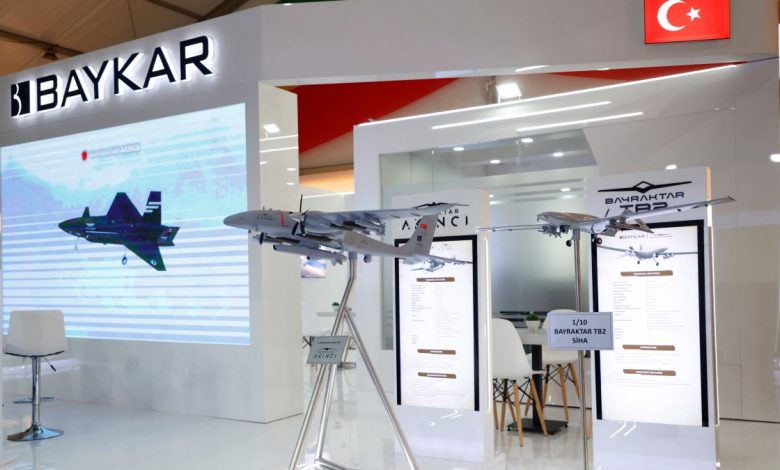
The drone powerhouse Baykar ranked 73rd with $1.9 billion in revenues, a 12.4% year-over-year decline. Roketsan’s sales rose 13% to $1.39 billion, ranking 87th, while the newcomer MKE entered the list ranking 93rd, with sales of $1.21 billion, a 17.4% year-over-year increase.
Meanwhile, nine of the top 100 arms companies were based in the Middle East, with combined revenues of $31 billion.
The three Israeli arms companies in the ranking accounted for more than half of that, as their combined revenues grew by 16% to $16.2 billion. In 2024, the backlash over Israeli genocidal actions in Gaza “seems to have had little impact on interest in Israeli weapons,” SIPRI researcher Zubaida Karim said, and many countries continued to place new orders.
China’s military firms struggle
The Asia and Oceania region was the only region to see the overall revenues of the 23 companies based there go down – their combined revenues dropped 1.2% to $130 billion.
But the authors stressed that the picture across Asia was varied and the overall drop was the result of a larger drop among China’s top arms makers, whose revenues fell 10% last year.
“A host of corruption allegations in Chinese arms procurement led to major arms contracts being postponed or canceled in 2024,” Nan Tian, director of SIPRI’s Military Expenditure and Arms Production Program, said in a statement.
“This deepens uncertainty around the status of China’s military modernization efforts and when new capabilities will materialize,” Tian noted.
The People’s Liberation Army was one of the main targets of a broader corruption crackdown ordered by President Xi Jinping in 2012, reaching the upper levels of the military in 2023 when its Rocket Force was targeted.
Eight top generals were expelled from the ruling Communist Party on graft charges in October, including the country’s No. 2 general, He Weidong. He had served under Xi on the Central Military Commission, China’s supreme military command organization.
Asian and Western diplomats say they are still trying to gauge the impact of the crackdown on China’s ongoing military rise and how far down it reaches through the command chain.
In contrast, Japanese and South Korean weapons makers saw their revenues increase last year, also driven by European demand.
Source: Daily Sabay