
Japan uses robotic dogs during airborne assault drill
Japan’s Ground Self-Defense Force (GSDF) deployed robotic quadruped drones during a January 2026 airborne assault exercise conducted by the 1st Airborne Brigade, marking the first time the unit integrated unmanned ground vehicles into its annual new-year descent training.
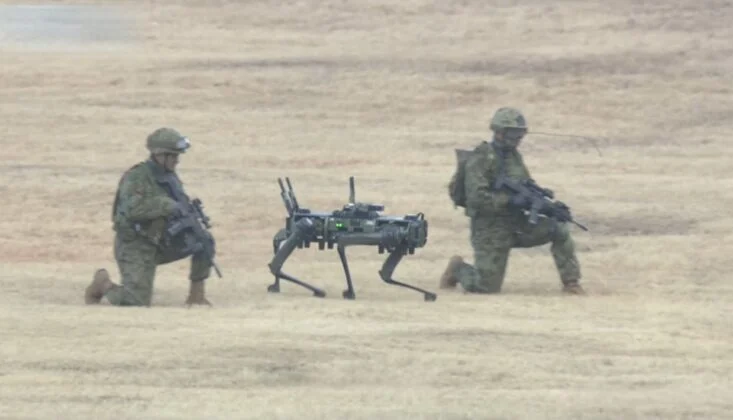
According to the training footage broadcast in Japan, the exercise featured an assault element inserting from two CH-47J helicopters, during which two Ghost Robotics quadruped unmanned ground vehicles were used to support the landing force.
The GSDF said in the broadcast captions that the robots were employed for “reconnaissance by UGV.” The footage showed the robotic platforms moving ahead of dismounted soldiers as they advanced across an open field.
Japanese forces have adopted these Robodog-kun drones for missions such as airfield defense, assault support, and helicopter-insertion scenarios where rapid ground reconnaissance is required in hazardous environments. During the demonstration, the robots were positioned forward of the assault team to identify threats before troops advanced.
Ghost Robotics’ quadruped platforms are designed as lightweight unmanned ground vehicles capable of traversing uneven terrain, carrying sensors, and providing real-time surveillance to reduce risk to personnel. The GSDF has been evaluating robotic systems across several units as part of a broader modernization effort focused on island defense and rapid-response operations.
The 1st Airborne Brigade, Japan’s primary airborne assault force, conducts its annual public descent training each January to showcase combined insertion capabilities, including helicopter air assault, ground maneuver, and integrated support systems. This year’s event highlighted the GSDF’s ongoing push to incorporate unmanned systems into frontline operations.
The introduction of quadruped robots during an airborne insertion drill underscores Japan’s aim to strengthen situational awareness in contested or high-risk landing zones, particularly in remote island environments where early threat detection is essential.