NATO Reconnaissance Aircraft Monitors Kaliningrad Region During Drone Attack
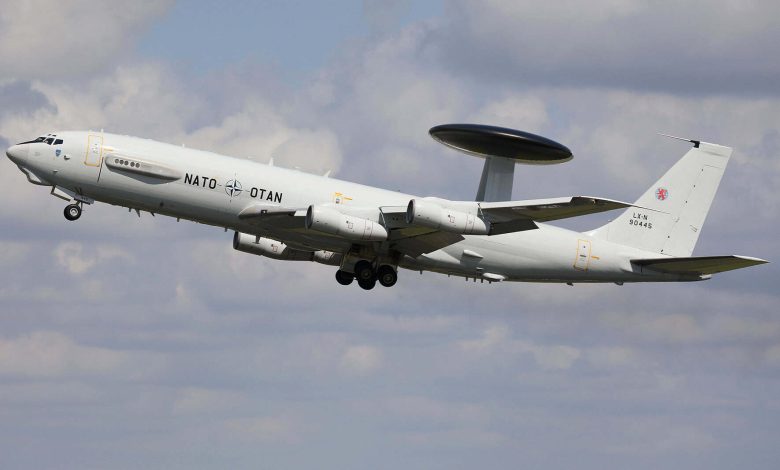
A NATO Boeing E-3A Sentry surveillance aircraft monitored the drone attack on Russia’s Kaliningrad region.
According to Militarnyi, citing flight tracking data from AirNav, the aircraft was identified by the callsign NATO01 and registration number LX-N90453.
The aircraft took off from Geilenkirchen Air Base in Germany and patrolled Polish airspace near Kaliningrad. Its flight coincided with a drone attack on the Russian city of Baltiysk, home to a Russian Baltic Fleet naval base.
The reconnaissance aircraft began circling near Gdańsk, Poland, around 7:30 p.m. local time, about an hour after an air raid alert was declared in Russia’s Kaliningrad region.
The aircraft remained in the area until about 8:20 p.m., then moved farther east toward the Polish city of Ostrołęka, where it continued patrolling until around 10:20 p.m. It then headed to Talsi Airbase in Latvia.
LX-N90453 is a Boeing E-3A Sentry airborne early warning and control (AEW&C) aircraft based on the Boeing 707 airframe. NATO operates it as part of the NATO Airborne Early Warning and Control Force.
The aircraft is based at Geilenkirchen Air Base in Germany, which hosts the multinational E-3A Component. The component operates 14 Boeing E-3A Sentry aircraft owned by NATO. Their crews are made up of military personnel from 19 NATO member countries.
In addition to its main base at Geilenkirchen, the component operates three forward operating bases: Konya in Turkey, Aktion in Greece, and Trapani in Italy. An additional forward operating location is situated at Ørland in Norway.
The E-3A Sentry detects, identifies, and tracks airborne and maritime targets, while also providing command and control for fighter aircraft. The aircraft relays the information it gathers to air, land, and naval forces in near real time.
Its detection range is up to 400 km for low-altitude targets and up to 520 km for medium-altitude targets. The aircraft can remain airborne for more than 10 hours, while in-flight refueling can extend mission duration.
According to NATO, a single E-3A flying at an altitude of 9,150 metres can provide radar surveillance coverage over an area of more than 312,000 square kilometres, roughly equivalent to the size of Poland.
Three aircraft conducting coordinated flights with overlapping surveillance areas can provide continuous radar coverage across the whole of Central Europe.
Source: Militaryni