
North Korea tests missile with maneuvering glide warhead
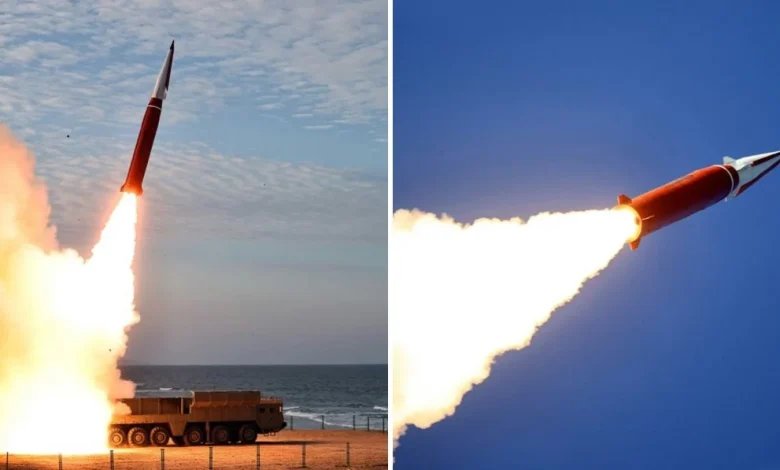
North Korea fired two short-range ballistic missiles from the Wonsan area toward the sea on Sunday, South Korea’s Joint Chiefs of Staff said, with the second missile flying more than 600 km (370 miles).
Kim Jong Un oversaw the launch, and North Korean state media called it a test of a “new type of weapon.”
South Korea said the first missile launched around 3 p.m. local time and flew about 450 km (280 miles). The second launched roughly three hours later, at 5:50 p.m., and flew farther and higher, reaching an altitude of about 70 km (43 miles) compared with roughly 60 km (37 miles) for the first, according to flight data broadcast on North Korean state television and cited by open-source analysts. South Korean and U.S. authorities said they were still analyzing the missiles’ exact specifications.
North Korea’s Missile Administration said the test marked “a significant step in the technological development of its weapons systems,” and Kim said the advance would give an adversary “an incurable headache.” A monitor shown in North Korean state media footage was labeled “Hwasongpho-11Ma-1 flight trajectory,” identifying the missile by name; North Korea did not publicly confirm what kind of warhead it carried. NK News, a Seoul-based outlet that tracks North Korea, said the projectile appeared to be an upgraded missile fitted with a hypersonic glide vehicle, a maneuverable warhead that separates from its booster and glides toward its target rather than following a fixed ballistic arc.
State media footage showed a flight-path graphic on a command-center screen that tracked the second missile through what appeared to be a pull-up maneuver, a sharp change in trajectory during flight that missile defenses have a harder time predicting. South Korean expert Chang Young-keun, cited by the Korea Herald, said the system paired a KN-23-style missile body with a hypersonic glide vehicle terminal section built to penetrate missile defenses while striking targets hundreds of kilometers away. He said it looked like a refinement of a system North Korea first tested last October rather than an entirely new weapon.

North Korea has tested hypersonic glide vehicles since September 2021, when it first flew the wedge-shaped warhead later associated with the Hwasong-8 missile. It has since tested at least two other missile types carrying similar warheads, the Hwasong-12B and the solid-fueled Hwasong-16B. In a January 2025 test of the Hwasong-16B, Japan estimated the missile flew about 1,100 km (680 miles) with an apogee near 100 km (62 miles); North Korea claimed a longer range and two separate apogees, an initial climb followed by a lower secondary peak consistent with a glide phase.
Sunday’s launches were North Korea’s 15th and 16th ballistic missile launches of the year, spread across nine test events, Japanese Defense Minister Shinjiro Koizumi said. That is roughly triple last year’s total of at least five missiles across four events, he said, calling the regional security situation “increasingly severe.” Japan lodged a formal protest, and South Korea’s National Security Council condemned the launch and called on North Korea to halt missile activity, saying it violated United Nations Security Council resolutions. The launches came about a week after North Korea’s previous test, on Sept. 12, and days after Pyongyang rejected a UN resolution demanding it halt its nuclear program.
Source: Defence Blog