Report: US Army Seeks to Produce 30,000 Next-Gen Cluster Shells Annually
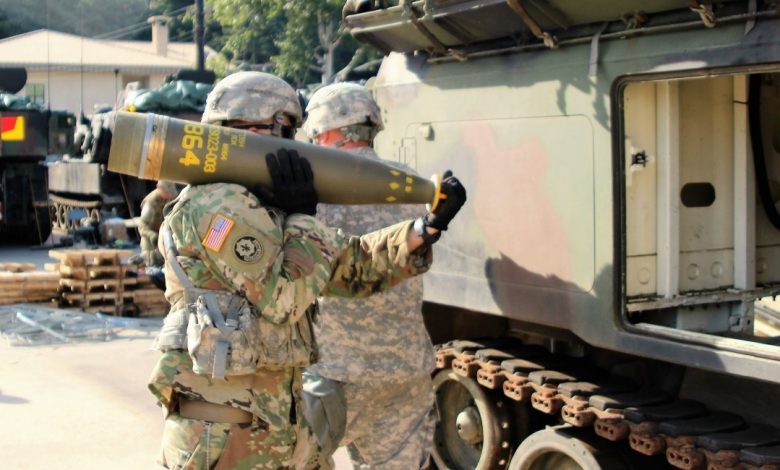

The US Army is soliciting potential manufacturers for XM1208 155mm cluster shells, with a targeted annual production rate of 30,000 rounds.
A recently released market survey states that the XM1208 can be sourced from multiple vendors, with the service requesting capacity projections from all interested suppliers.
“This capacity may be achieved with multiple sources therefore, sources shall include their minimum sustaining and maximum capacity rates,” the notice stated.
The US announced in 2023 that it would provide cluster munitions to Ukraine as Washington and its European partners struggled to scale up artillery output.
Cluster weapons enable a single round to disperse numerous submunitions, increasing the likelihood of target impact — particularly during area-effect fire where precision engagement is not feasible.
Successor to Unguided DPICM
The XM1208 is being developed as a modern successor to the Dual-Purpose Improved Conventional Munition (DPICM), which has been in service since the 1970s.
The 39-caliber-compatible XM1208 is suitable for use with the M109A6/A7 Paladin and M777A2 howitzers. It can be fired to a maximum range of roughly 14 miles (22.53 kilometers), according to a 2025 Joint Program Executive Office for Armaments and Ammunition brochure.
Each XM1208 carries nine M99 submunitions, dispensed in flight using an M762/A1 electronic-time fuze.
After separation, the bomblets arm and stabilize via a drag belt before detonating roughly 1.5 meters (5 feet) above the ground, scattering around 1,200 pre-formed tungsten fragments over the impact zone.
Should the proximity fuze fail, the submunition can still function through one of four backup mechanisms — point‑detonation upon impact, a pyrotechnic fail‑safe, and two secondary electronic fuzes.
Fewer Duds
Together with the XM1180, the XM1208 is designed to improve area-effect fire missions and significantly reduce unexploded submunitions relative to older DPICM shells.
Older cluster rounds often left a percentage of bomblets unexploded, littering battlefields with lethal ordnance that could threaten civilians long after fighting had ceased.
DPICM dud rates are reportedly assessed at approximately 2-14 percent, whereas Russian-made cluster munitions have been recorded with failure rates approaching 40 percent.
The two new munitions are being tailored for distinct roles: the XM1208 for engaging light vehicles and personnel, and the XM1180 for defeating heavily armored targets.
“The XM1208 projectile will provide US ground forces with a capability to effectively engage imprecisely located enemies within an area, emphasizing personnel and light materiel missions,” the market survey added.