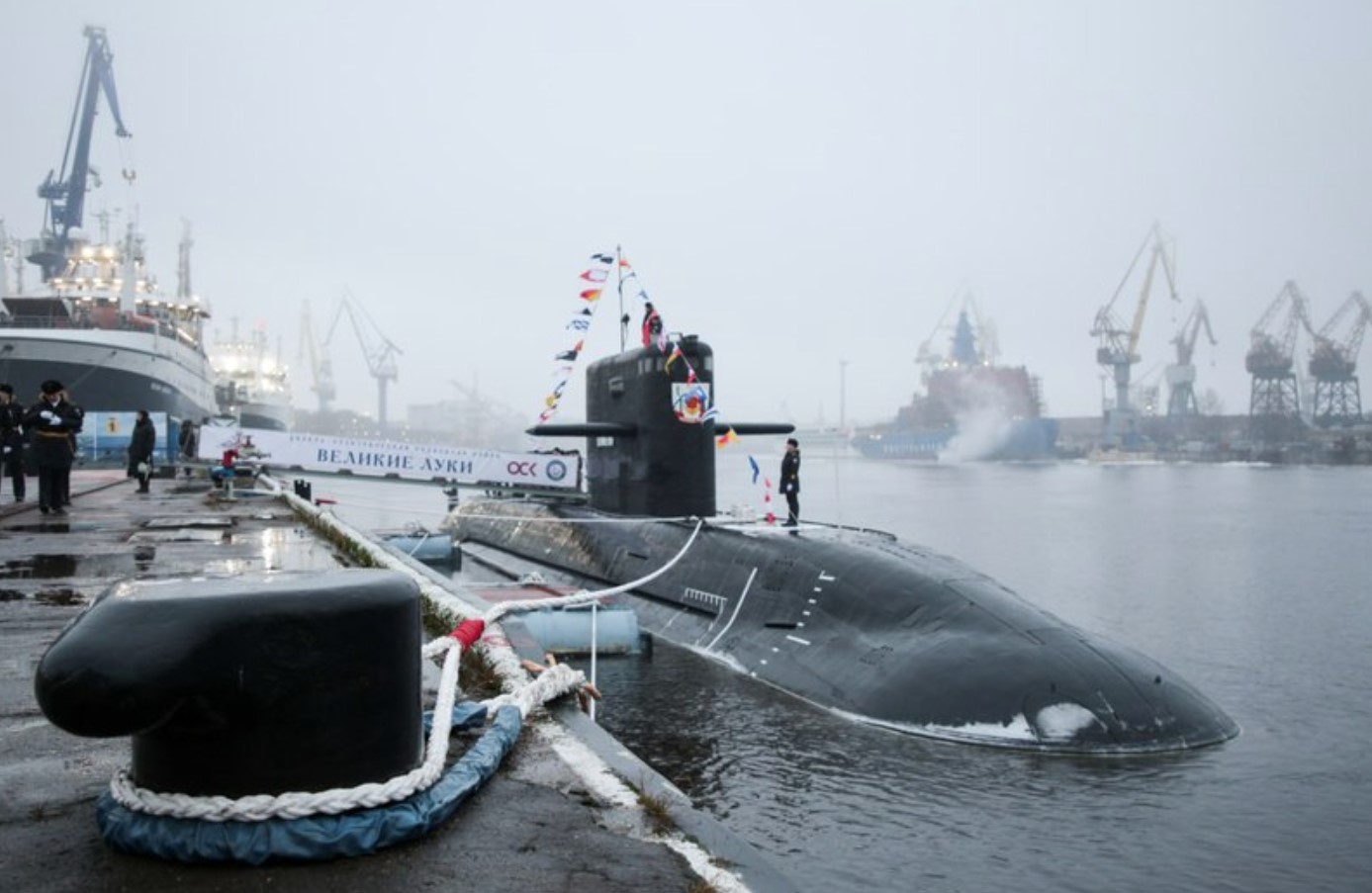
As part of a cooperation that has been ongoing since the 2010s, Russia transferred technical documentation and materials for submarine testing to China. The technology exchange continued even after the start of Russia’s full-scale invasion of Ukraine in February 2022.
This is stated in the report “A Marriage of Convenience?” by the research organization Center for Advanced Defense Studies (C4ADS).
According to experts, Sino-Russian cooperation encompasses noise-reduction technologies, non-nuclear propulsion systems, automated command, control, and weapon management systems, as well as submarine hull design.
China’s submarine fleet, particularly its non-nuclear component, initially relied on Soviet and Russian technologies, although the Chinese Navy later transitioned to domestically produced platforms. At the same time, U.S. government sources claim that China’s nuclear submarine program continues to receive significant Russian technical assistance, particularly in the area of reducing acoustic signature.
The Russian Central Design Bureau for Marine Engineering Rubin—a subsidiary of the state-owned United Shipbuilding Corporation (USC)—plays a key role in the cooperation between the two countries. The bureau is subject to sanctions imposed by the U.S., the EU, and Japan.
Trade data confirms this cooperation. According to these data, from at least August 2015 through April 2023, Rubin collaborated with procurement agencies of the People’s Liberation Army of China and China Shipbuilding and Offshore International Co., Ltd. (CSOC) on the joint development of submarine technologies.
CSOC is the foreign trade division of the China State Shipbuilding Corporation (CSSC), which builds civilian and military vessels.
During this period, Rubin made 12 deliveries to the PLA Navy’s procurement agencies and CSOC with a total value of over $80 million. According to the report’s authors, the vague descriptions of these deliveries likely pertain to conceptual designs for a non-nuclear submarine.
In particular, two deliveries from Rubin to CSOC in October 2019 and January 2020 included documentation regarding various submarine-related tests. Among them were tests to evaluate cavitation, a natural phenomenon that impairs the stealth capabilities of submarines.
According to a maritime security expert consulted by the report’s authors, these details indicate that Rubin helped CSOC test the effectiveness of Chinese technologies for reducing submarine noise.
Available data also indicates that from December 2019 to September 2022, CSOC supplied Rubin with materials for submarine testing. These included control devices and components for test consoles used to evaluate the submarine’s information and control system. Documents related to a shipment in September 2022 also mention a contract for joint design and production.
As a reminder, in late September, Ukrainian hackers claimed to have obtained a large cache of technical documentation related to Russian naval systems. According to their statement, the breach encompassed the scientific, technical, design, testing, and operational infrastructure of Russian naval developments related to the submarine fleet, navigation, hydroacoustics, and marine robotics.
Source: Militaryni