U.S. Air Force to arm C-17 cargo aircraft with cruise missiles
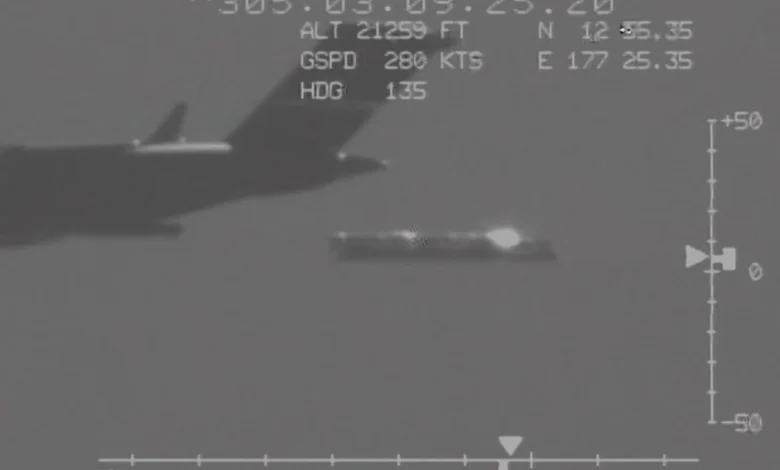
U.S. Air Force leaders say C-17 and C-130 cargo aircraft will soon launch cruise missiles dropped from their cargo holds on standard airdrop pallets, with the service planning to field the capability in 2027 under a program now known as Dragon Cart. Air Force Chief of Staff Gen. Kenneth S. Wilsbach described the plan on Nov. 6 at the Airlift/Tanker Association’s 2026 Symposium in Kissimmee, Florida, Air & Space Forces Magazine reported, telling mobility airmen that the weapon would change how the service uses its airlift fleet.
“As you might gather, capabilities like FAMM-P blur the distinction between our combat air forces and mobility air forces mission sets. That’s a cultural shift we need to be prepared for, and I need every mobility Airman in the room to embrace that change,” said Gen. Kenneth S. Wilsbach, U.S. Air Force Chief of Staff.
The missile Wilsbach referred to, FAMM-P, is the palletized version of the U.S. Air Force’s Family of Affordable Mass Missiles, a program meant to build up munitions stockpiles with cheaper, simpler air-to-ground cruise missiles bought in large numbers. A second version, FAMM-L, is carried on lugs under fighters and bombers, and both are designed for ranges of 250 to 500 miles (400 to 800 km).
The palletized system loads several cruise missiles into a container mounted on a standard airdrop platform, which crews push out of the cargo ramp like any other airdrop load. Once clear of the aircraft, the container deploys a parachute and releases the missiles, which start their engines, pull up and fly to their targets. Wilsbach told the symposium that the concept “is more complex than just rolling dumb munitions off the back of an airplane.”
“This system is modular and smart; the weapons are networked and affordable,” said Gen. Kenneth S. Wilsbach.
Lt. Gen. Dan Tulley, commander of Air Mobility Command, told the same conference that C-130s and C-17s could deliver “mass fires on the adversary” with the new weapon.
Wilsbach said each FAMM-P “costs about a tenth” of a Joint Air-to-Surface Standoff Missile (JASSM) and that its lead time is “months, not years,” which is the main reason the service is pursuing it. The FAMM missiles are targeted at about $218,000 per round, while a JASSM costs between about $1.5 million and $2.6 million, depending on the variant and the estimate.
“Solutions like FAMM-P augment fighter rails and bomber bays to creatively scale our combat power at a fraction of the time and cost of more exquisite options,” said Gen. Kenneth S. Wilsbach.
The war with Iran showed how quickly the U.S. stockpile of expensive standoff missiles can be used up. U.S. aircraft fired about 1,100 JASSM-ERs during Operation Epic Fury, according to an April 2026 analysis by the Center for Strategic and International Studies, out of what Air & Space Forces Magazine, citing the same study, put at an estimated 4,400 in the inventory before the conflict. The CSIS analysis put JASSM lead times historically at about 24 months from order to delivery, recently stretching to 36 months or more, with another year needed to complete a full production lot.
The U.S. military had been pushing missiles out of C-17 cargo bays for years before the current program, using a parachute-and-extraction method to launch ballistic missile targets for missile defense tests. In 2013, the Missile Defense Agency and Lockheed Martin dropped a full-scale, unpowered replica of the extended Medium Range Ballistic Missile (eMRBM) target from a U.S. Air Force C-17 at 25,000 feet over Yuma Proving Ground, Arizona, to validate the air-launch equipment and carriage extraction system. On Oct. 31, 2015, a C-17 from the Air Force Test Center at Edwards Air Force Base, California, air-launched a live eMRBM from just below 25,000 feet over the western Pacific during the FTO-02 Event 2a test, in which THAAD and Aegis Ballistic Missile Defense systems engaged the targets.
The palletized strike concept itself began in 2019 as the Air Force Research Laboratory’s Rapid Dragon experiments, which used JASSM-ER missiles as the payload. In July 2021, crews airdropped modular containers loaded with JASSM-ER simulants from an EC-130SJ and a C-17A over White Sands Missile Range, New Mexico, and retargeted a missile emulator in flight. A live JASSM-ER launched from a cargo aircraft followed at Eglin Air Force Base, Florida, in December 2021, and later tests used a six-weapon configuration on the C-130 and a nine-weapon configuration on the C-17.
A parallel effort called Franklin aimed to produce long-range cruise missiles for about $100,000 per round, which would let the pallets carry cheaper weapons than the JASSM-ER. The U.S. Air Force has already shown it can move fast on that side of the program, as The Defence Blog reported when the service built a cheap cruise missile in record time.
In April 2026, the Air Force Life Cycle Management Center renamed the effort Dragon Cart and made it an official program of record, with officials saying they aimed to field the system in 2027 after awarding prototype contracts in late May 2026.
The Pentagon announced framework agreements with three companies for the FAMM program on July 15, 2026: Anduril, with its Barracuda-500; CoAspire, with the Rapidly Adaptable Affordable Cruise Missile; and Zone 5 Technologies, with the Rusty Dagger. The agreements are not missile orders, since the weapons still have to complete testing and qualification and actual purchases depend on Congress approving the multiyear deals.
The U.S. Air Force’s fiscal 2027 budget request includes $355 million to buy 1,000 FAMM weapons, Air & Space Forces Magazine reported, citing budget documents, and budget projections show plans to acquire about 28,000 FAMM missiles across both variants over five years at a total cost of $12.6 billion. Anduril has said the service intends to buy up to 8,000 rounds a year across all vendors once production ramps up.
Source: Defence Blog