US Navy Taps Saronic to Rapidly Produce Corsair Autonomous Surface Vessels

The US Navy has awarded Saronic a $392-million production contract for its Corsair autonomous surface vessel (ASV).
Approximately $200 million will be advanced at the outset, with production expected to be completed in under 12 months.
The decision reflects a broader Pentagon effort to accelerate acquisitions and field advanced unmanned systems far more rapidly than traditional procurement timelines allow.
“Prototype to production in under 12 months,” Secretary of the US Navy John C Phelan wrote on X.
“The Saronic OTA proves how we’ll build a hybrid manned–unmanned fleet: open competition, real contracts, real hardware for Sailors and Marines, not slides. This is now the standard.”
Corsair
The Corsair was originally designed by Saronic for the Pentagon’s Replicator program, which aims to field swarms of thousands of expendable unmanned platforms to deter a potential Chinese invasion of Taiwan.
Navy officials say the platform is designed to extend the operational reach of manned vessels while reducing sailors’ risk.
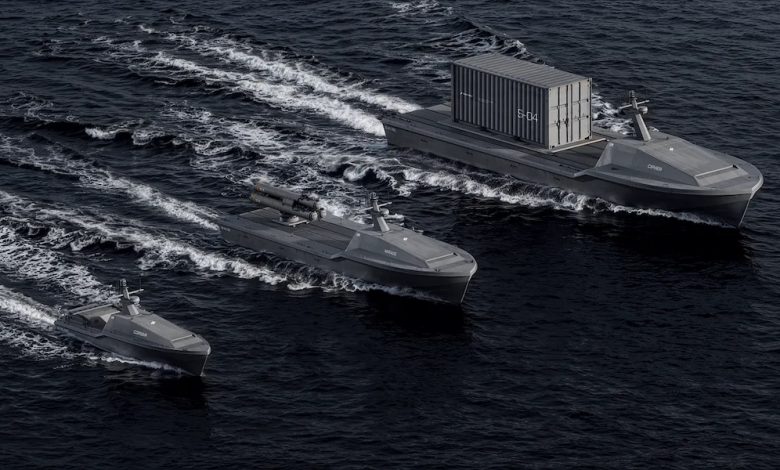
At 24 feet (7.3 meters), the Corsair is Saronic’s fourth-largest autonomous surface vessel, following the 150-foot (45-meter) Marauder, the 60-foot (18-meter) Cipher, and the 40-foot (12-meter) Mirage.
The platform can travel up to 1,000 nautical miles (1,852 kilometers/1,151 miles) without refueling at speeds exceeding 35 knots (over 65 kilometers/40 miles per hour) while carrying a payload of up to 1,000 pounds (453 kilograms).
It is designed for a range of missions, from maritime domain awareness to delivering kinetic and non-kinetic effects.
Future Plans
Saronic is developing five prototypes and plans to produce hundreds of vessels in the near future, with the capacity to scale production into the thousands.
Vertical integration of hardware, software, and AI enables lower-cost, high-rate manufacturing, according to the company.
In a statement, Saronic commended the Pentagon for embracing commercial innovation in its procurement process.
“From day one, we built our company around rapid innovation and scaled manufacturing, enabling us to transition Corsair from prototype to fielded capability in high-rate production in under a year,” the Texas-based firm stated.
“We commend the Department of War and Secretary of War for opening acquisition pathways to non-traditional defense companies and for prioritizing commercial solutions that deliver quickly and effectively.”