
Ukrainian intel: Russia paused Kinzhal missile output
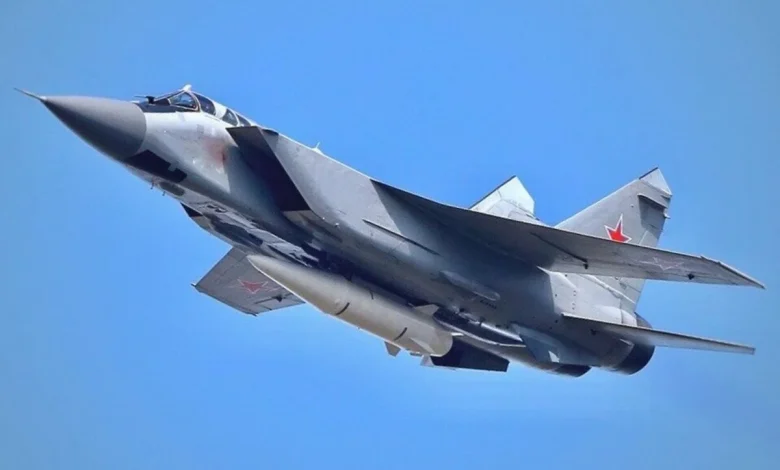
Russia’s prized “unstoppable” hypersonic missile has gone dark, and Ukrainian military intelligence says Moscow pulled the plug on purpose to feed a different weapon entirely.
Vadym Skibitsky, deputy head of Ukraine’s Defense Intelligence Directorate, known by its Ukrainian acronym HUR, told the outlet RBC-Ukraine that Russia halted production of its Kh-47M2 Kinzhal ballistic missile back in April, redirecting the rocket fuel and components once earmarked for that program into other ballistic missiles Moscow considers more effective.
The Kinzhal, whose name translates to “dagger” in Russian, has been marketed by the Kremlin since its 2018 debut as a hypersonic wonder weapon, an aircraft-launched missile derived from the ground-based Iskander-M short-range ballistic missile and capable of flying at roughly ten times the speed of sound. Russia fires the Kinzhal exclusively from MiG-31K interceptor jets, and every launch has historically triggered nationwide air raid sirens across Ukraine the moment those aircraft take off, since the missile’s extreme speed leaves Ukrainian air defenses only a narrow window to react.
Skibitsky said Ukrainian intelligence has tracked the production shift since April, tying it directly to a broader reshuffling of Russia’s missile manufacturing priorities. According to Skibitsky, Russia managed to increase its ballistic missile output partly by halting Kinzhal production altogether, freeing up rocket fuel that once went into Kinzhals for other ballistic missile types instead. He added that Russia also suspended production and combat use of the Kh-32, an upgraded version of the older Kh-22 anti-ship cruise missile that Russian forces have repeatedly repurposed for strikes on land targets in Ukraine despite the weapon’s original design as a Soviet-era ship killer, redirecting the funding and components once allocated to that program toward missile types Russian planners now consider more effective.
Accuracy problems appear to sit at the center of Moscow’s decision, at least for the Kinzhal. Skibitsky offered a specific technical benchmark to illustrate just how far the missile has fallen short of its advertised performance. He said an effective guided missile should not miss its target by more than 5 to 7 meters (16 to 23 feet), whereas the Kinzhal’s actual deviation runs to 30 meters (98 feet) or more.
That gap, a miss distance far beyond what a modern guided missile is expected to achieve, undercuts much of the propaganda value Russia has attached to the Kinzhal since President Vladimir Putin first unveiled it as part of a suite of what he called invincible next-generation weapons. Ukrainian air defense crews have shot down multiple Kinzhals since 2023 using American-made Patriot air defense systems, missile batteries the U.S. supplied to Ukraine specifically because their radar and interceptor missiles are capable of tracking and destroying fast, high-altitude threats, a track record that has chipped away at the missile’s reputation as unstoppable even before this reported production pause.
The shift also fits a pattern Ukrainian intelligence has flagged in Skibitsky’s broader assessments of Russia’s missile stockpiles, where officials have previously noted that Russia’s strategic reserves across multiple missile types, including the Iskander, the Kalibr cruise missile and the Kh-101 air-launched cruise missile, have dropped below the roughly 30 percent threshold that normally defines a healthy reserve under Russian military planning standards.
That kind of depleted cushion pushes Russian defense industry toward exactly the sort of triage Skibitsky described, concentrating scarce components and propellant on whichever missile types the military can still reliably manufacture and field, rather than spreading resources thin across an entire arsenal, including weapons whose performance in real strikes has repeatedly disappointed.
None of this means Russia has abandoned the Kinzhal program permanently, and Skibitsky’s comments describe a pause tied to manufacturing priorities rather than a formal cancellation of the missile or the MiG-31K aircraft that carry it. What the account does suggest, though, is a Russian military industrial base under enough strain that it can no longer afford to keep every headline weapon in production simultaneously, forcing planners in Moscow to bet on missiles that actually hit what they aim at over missiles that mostly hit the news cycle instead.
Source: Defence Blog