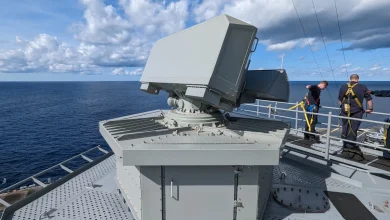
VisionWave’s Argus links orbital imaging with interceptors and jammers, creating an AI-powered, space-enabled kill chain for global counter-drone defense.
A US firm wants to take counter-drone warfare above the atmosphere, pushing an AI-powered counter-unmanned aerial system (C-UAS) into development for operations directly from orbit.
California-based VisionWave’s Argus concept will use high-frequency (HF) signals to coordinate multiple weapon systems from space.
It will combine space-based imaging systems with interceptors and effectors to act as a global anti-drone kill chain.
From orbit, Argus satellites equipped with electro-optical/infrared payloads would monitor borders, ports, and other high-value sites, scanning for the “full spectrum” of small and tactical drones.


Its AI can help identify key structural components such as rotors, fuselage, and wings, then rebuild a virtual 3D model of each drone and pair it with a flight profile to assess how much of a threat it poses.
“Argus is intended to be designed to provide nations with a theater-scale shield that can detect hostile drones from space, classify them instantly, and coordinate a precise response in real time, even in highly contested environments,” VisionWave Chairman Doug Davis said.
The System’s Offense and Defense
A dedicated encryption layer protects Argus’ GPS and control links using public-key authentication, shielding the system against command spoofing.
With AI-based HF connectivity, VisionWave claimed the system could remain operational even if cellular or satellite networks are compromised.
On the offensive side, Argus would pair with interceptor drones, ground-based weapons, radio-frequency jammers, and even high-powered lasers to support a mix of soft- and hard-kill options.


VisionWave said the system will rely on existing company technologies to help shorten development timelines and push it more quickly toward production.
The firm is partnering with Israeli-based BladeRanger on the project.
“Our objective is to capture a major share of the global defense C-UAS market by offering a solution that is space-enabled, resilient, and ready for near-peer electronic warfare,” BladeRanger CEO Shmulik Yannay stated.
-
-
-
-

-