The United States Navy has awarded Pratt & Whitney a contract worth up to $1.6 billion to sustain the F135 propulsion system used across all variants of the F-35 fighter jet.
The undefinitized contract covers a broad range of support activities through November 2026, including global maintenance, spare parts, software updates, and depot repair for U.S. and allied operators.
According to the contract announcement, the not-to-exceed $1,606,190,091 award includes cost, cost-plus-fixed-fee, cost-plus-incentive-fee, and fixed-price-incentive-fee elements.
The work supports “recurring sustainment support, program management, financial and administrative activities, propulsion integration, replenishment spare part buys, engineering support, material management, configuration management, product management support, software sustainment, security management, Joint Technical Data updates, support equipment management, depot level maintenance and repair for all fielded propulsion systems at the F-35 production sites and operational locations.”
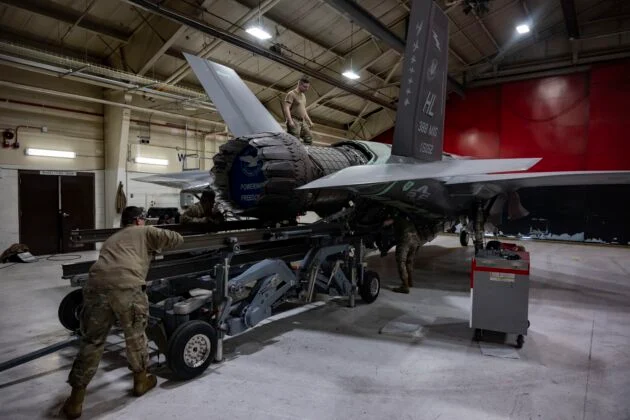
The F135 engine, manufactured by Pratt & Whitney and operated by the U.S. Air Force, Navy, and Marine Corps — as well as several partner nations — is the core propulsion system of the F-35 air vehicle. The new contract ensures that the global fleet continues to receive unit-level and depot-level support as the number of jets in service continues to grow.
The announcement states that the agreement “provides global maintenance services for the F135 propulsion system at unit and depot levels, as well as replenishment spare parts.”
A total of $98,975,737 of the obligated funds will expire at the end of the current fiscal year.
Work is expected to be completed by November 2026.
The F135 engine remains one of the most complex and maintenance-intensive propulsion systems in U.S. aviation, powering the F-35A, F-35B, and F-35C variants. As more allied nations adopt the aircraft and as operational tempo increases, global sustainment contracts like this one are essential for maintaining fleet readiness, parts availability, and system reliability.