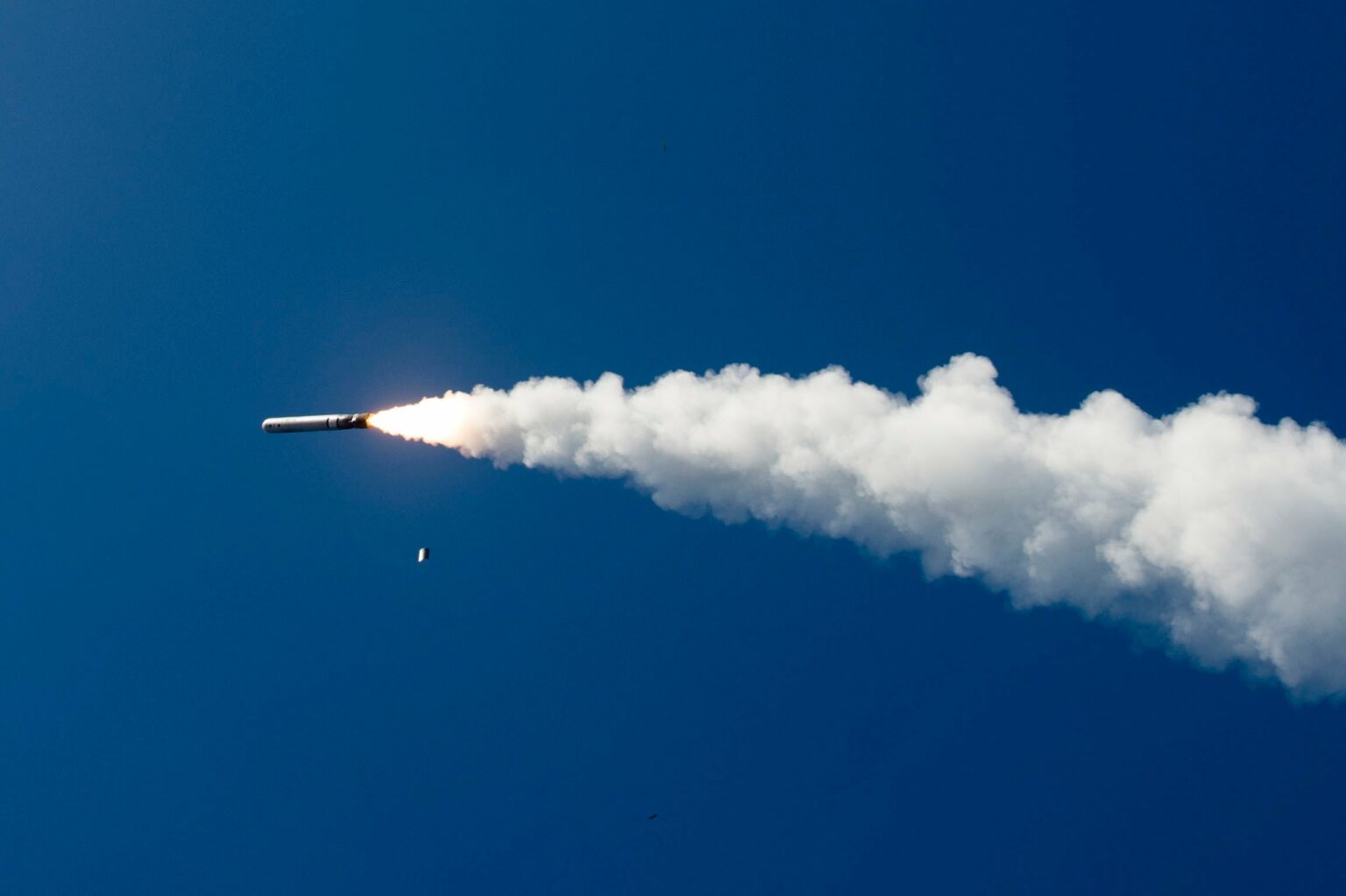
The Tomahawk missile is one of the most influential precision-strike weapons ever fielded — quiet, long-range, and relentlessly adaptable.
The cruise missile, which debuted in combat around the 1990s, has transformed surface ships and submarines into strategic strike platforms capable of hitting mission-critical targets deep inland without putting pilots or aircraft at risk.
This guide breaks down how the Tomahawk missile works, why it matters, and how it shapes modern naval strike operations.


Why the Tomahawk Missile Exists: Reach Minus Risk
The Tomahawk Land-Attack Missile (TLAM) was born out of the concept of striking high-value land targets from far outside enemy defenses.
Rather than relying solely on bombers or forward airbases, the US Navy wanted a weapon that could be launched from ships and submarines, fly hundreds of miles, and hit precisely — day one, minute one.
Raytheon became the primary muscle behind the development of the Tomahawk missile. Early versions, like the Block I, were preprogrammed for land-attack missions, while later Block II and III variants added improved guidance, range, and the ability to engage naval targets.
Successive upgrades, including Block IV, introduced networked navigation, in-flight retargeting, and enhanced flexibility, transforming Tomahawk into a versatile missile family capable of adapting to modern combat scenarios.
Over time, its role expanded from niche deep-strike weapon to a flexible, repeatable tool of conventional deterrence.
How It Works: Subsonic, Stealthy, and Surgical
The Tomahawk has been a cornerstone of US naval strike capability for decades, evolving through multiple blocks to meet changing threats and mission requirements.
Despite successive upgrades, the missile’s core physical and operational characteristics have remained largely unchanged.
It has retained its familiar form factor across generations: roughly 5.56 meters (about 18.2 feet) long with a deployed wingspan of about 2.6 meters (8.8 feet) and a diameter of 52 centimeters (20.5 inches), as well as a launch weight of around 1,300 kilograms (2,870 pounds).
Performance also remains consistent, with sustained high subsonic cruise speeds near Mach 0.7–0.8 (860-980 kilometers/535-610 miles per hour), and full compatibility with surface ship vertical launch systems and submarines via torpedo tubes.
The table below outlines how the major Tomahawk variants differ, focusing on changes in designation, navigation and guidance systems, and key capabilities.
| Variant | Designation | Key Capabilities | Navigation and Guidance |
| Block II (Baseline) | TLAM‑C | Early conventional land‑attack capability; preplanned mission profiles | Inertial Navigation + TERCOM |
| Block III | TLAM‑C or TLAM‑D | Improved accuracy, longer range, lighter airframe than Block II | GPS + INS + TERCOM + DSMAC |
| Block IV | TLAM‑E (Tactical Tomahawk) | In‑flight retargeting, loiter capability, mission flexibility | GPS/INS + DSMAC + two‑way satellite datalink |
| Block V | Modernized TLAM | Service‑life extension, upgraded navigation and communications | Enhanced GPS/INS + modernized datalink |
| Block Va | Maritime Strike Tomahawk (MST) | Engages moving naval targets; restores anti‑ship role | GPS/INS + networked targeting + seeker |
| Block Vb | TLAM w/ JMEWS | Enhanced effects against hardened and complex land targets | GPS/INS + advanced targeting logic |
The Vertical Launch Revolution
While it was not the first missile launched from a vertical launch system (VLS), Tomahawk became one of the most consequential weapons to fully exploit VLS and submarine torpedo tubes.
A warship on routine patrol could suddenly execute deep strikes against critical targets hundreds of miles inland. In doing so, Tomahawk helped turn naval platforms into persistent, stand‑off strike assets rather than purely sea‑control tools.

The Tomahawk’s Limitations
Despite its long service and proven effectiveness, the Tomahawk missile has limitations that influence how and when it is employed in modern conflicts.
- Subsonic speed: Tomahawk prioritizes range and precision over speed, relying on low‑altitude flight and planning rather than rapid penetration.
- Vulnerability to advanced air defenses: If detected, it can be challenged by modern, layered air defense systems, especially without coordinated salvos.
- Long flight time: Extended time‑to‑target reduces effectiveness against mobile or time‑sensitive targets.
- Limited mission scope: Designed primarily for land‑attack missions, with only newer variants offering a restored anti‑ship role.
- Not a standalone solution: Against peer adversaries, Tomahawk is most effective as part of a broader strike package rather than a single‑weapon answer.
Why Tomahawk Still Matters
Tomahawk’s continued strategic value is driven by persistent use in real-world operations and evolving demand among US allies.
The US and the United Kingdom remain the primary operators, and US launchers have fired thousands of Tomahawks in combat, demonstrating reliability and adaptability over decades.
Australia has now joined this group, successfully firing its first Tomahawk from a Hobart‑class destroyer, becoming the third nation to both acquire and employ the missile.
Japan is also procuring hundreds of Tomahawks to deploy on Aegis destroyers, alongside receiving training, as part of its expanded defensive posture in a more contested Indo‑Pacific.
Other potential users, such as Germany, Poland, and the Netherlands, have shown interest or initiated acquisition plans, though not all have yet fielded or fired the system.
Collectively, this blend of combat heritage, allied demand, and unmatched long‑range precision firepower explains why Tomahawk continues to be a cornerstone of maritime strike doctrine — even as it transitions toward future long‑range strike systems.