U.S. Army backs new way to make long-range artillery shell motors
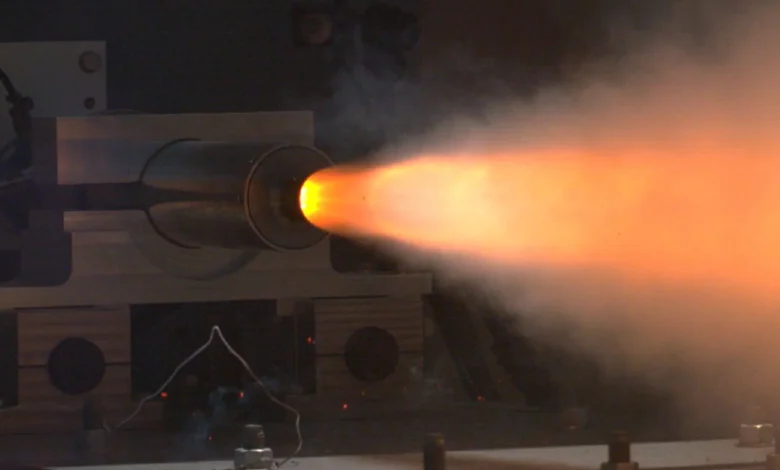
The U.S. Army has awarded Firehawk Aerospace a $14.5 million contract to mature base bleed propulsion made from thermoplastic propellant, the technology that helps 155 mm artillery shells fly farther, according to a Department of War contract announcement.
The firm-fixed-price deal covers work in Addison, Texas, the company’s headquarters, through Nov. 30, 2028. The Army obligated the full $14,549,604 at award from fiscal 2026 research, development, test and evaluation funds. Army Contracting Command at Aberdeen Proving Ground, Maryland, solicited bids online and received one offer, from Firehawk.
The contract is to “mature thermoplastic-based base bleed propulsion technology,” the announcement said. Firehawk is listed as a small business.
A base bleed unit sits at the back of an artillery shell. When a shell flies, the air behind its flat base forms a low-pressure wake that pulls it backward, and that base drag eats into range. A base bleed unit holds a slow-burning propellant grain. The grain lights at firing, then bleeds hot gas into the wake as the shell flies, filling the low-pressure area and cutting drag so the shell travels farther. The unit gives no thrust of its own.
Most base bleed grains today are made with cast-and-cure methods, in which propellant is mixed, poured into molds and left to harden. Firehawk uses a thermoplastic binder that can be melted and formed. The company says this lets it make propellant faster and change a grain’s shape without new tooling. Firehawk said in August that “legacy cast-and-cure processes are slow, labor-intensive, and difficult to scale.”
If the thermoplastic process works at volume, it could give the Army a second way to make base bleed grains, at a time when artillery propellant production is still a bottleneck.
This isn’t Firehawk’s first base bleed work. In August 2026, the company won a $24 million contract through the Pentagon’s Industrial Base Analysis and Sustainment program to expand propellant production for the M1128 155 mm base bleed projectile. The M1128 is an extended-range high-explosive round built by General Dynamics Ordnance and Tactical Systems for the M777A2 and M109A7 howitzers. Under that deal, Firehawk said it would raise annual propellant capacity to 740,000 pounds (about 336,000 kg), and later to 3.1 million pounds (about 1.4 million kg) once its Oklahoma plant reaches full capacity.
General Dynamics and Firehawk had signed a teaming agreement three months earlier. Announced on May 4, it covers 155mm base bleed motors for direct commercial sales abroad. General Dynamics said Firehawk brings “thermoplastic propellant formulations” and “injection and compression molding processes” to the partnership, while General Dynamics handles metal parts and integration of the finished munition.
“Firehawk Aerospace is proud to be at the forefront of innovation in base bleed production,” Firehawk chief executive Will Edwards said at the time.
Firehawk started out building hybrid rocket engines and later moved into solid rocket motors and 3D-printed propellant. In 2023, the U.S. Army Applications Laboratory gave it a Small Business Innovation Research Phase III contract to build analogs of the motors for Javelin, Stinger and the Guided Multiple Launch Rocket System. In September 2025, the U.S. Air Force awarded it $4 million to develop 3D-printed thermoplastic solid rocket propellant to extend missile range.

This year, the U.S. Army picked Firehawk as one of four new suppliers for the Hydra-70 rocket, alongside iRocket, Nammo Perry and Albers. The company is building a propellant plant in Lawton, Oklahoma, near Fort Sill, which is home to the U.S. Army’s field artillery school.
The new Army contract runs through Nov. 30, 2028, with all work in Addison.
Source: Defence Blog