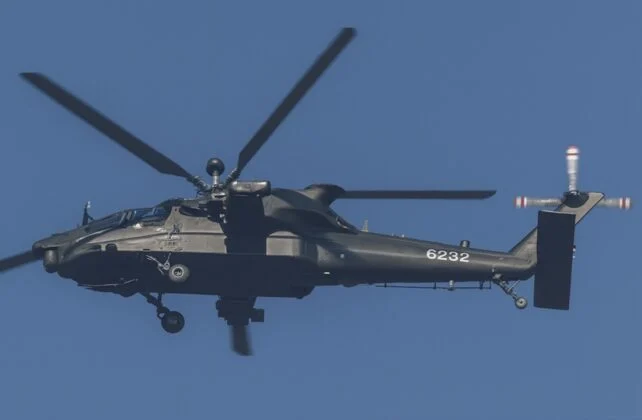
Images of a new prototype attack helicopter in China—designated the Z-21—have surfaced on Chinese social media, showing what appears to be a twin-seat, twin-engine platform closely modeled after the American AH-64 Apache.
The Z-21, painted matte black and bearing the tail number 6232, was photographed during a new test flight. Based on visible design features, the aircraft shares many structural and functional similarities with the U.S.-made AH-64, including a three-point wheeled undercarriage, tandem seating arrangement, chin-mounted autocannon, and side-by-side engine placement.
According to technical assessments, the Z-21’s nose section houses a large optical sensor suite providing the gunner with an unobstructed forward view. A 30mm chain gun is mounted beneath the cockpit in a traversable configuration, aligned with a gunner’s visor for visual targeting. The cockpit itself features armor protection on all sides to enhance crew survivability in contested environments.
The helicopter’s wingstubs accommodate two hardpoints per side, supporting a combination of short-range air-to-air missiles, anti-tank guided weapons, and both guided and unguided rocket pods. Analysts say this configuration allows the Z-21 to strike a wide range of ground and aerial targets, consistent with typical attack helicopter mission profiles.

Chinese defense media have referred to the Z-21 as “the god of war in the air,” citing claimed top speeds of 350 km/h and the ability to carry up to 16 guided missiles. Unverified reports also indicate the platform has completed live-fire exercises and operational testing in Tibet’s high-altitude terrain—conditions that posed difficulties for the earlier WZ-10 attack helicopter.
The Z-21 is believed to be an advanced development within China’s rotary-wing modernization efforts, offering increased payload capacity, longer range, and improved sensor integration. It remains unclear whether the platform will enter mass production or serve as a limited high-performance complement to existing fleets.
The appearance of the Z-21 reflects China’s continued effort to narrow the capability gap with U.S. rotary-wing aviation. The emergence of a helicopter resembling the AH-64—backed by testing in difficult terrain and armed with guided strike capabilities—raises questions about Beijing’s ability to replicate or adapt advanced Western designs. As China seeks to expand its military aviation exports, the Z-21 could also compete with U.S.-origin helicopters in third-party markets where political alignment or cost factors influence procurement.
-
-
-
-
-